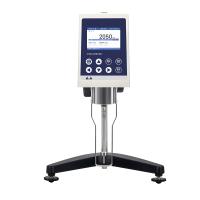
Solder paste viscosity measurement is a critical process because it directly affects the flow and coating performance of solder paste, which affects the manufacturing quality and reliability of electronic devices. Measuring the viscosity of solder paste is very important during solder paste manufacturing and electronics assembly. If the viscosity of the solder paste is too high or too low, it can lead to poor soldering or other production problems. Therefore, using a Rotational Viscometer can help ensure the quality and consistency of the solder paste, thus ensuring soldering quality and process stability.

Solder Paste Viscosity Measurement Method
Rotational viscometer measurement: The Rotational Viscometer is a common tool for measuring the viscosity of liquids. It can measure the viscosity of solder paste by measuring the torsional force of the coating formed by the liquid in the cylinder at a fixed rotational speed. In the measurement of solder paste viscosity, a multi-point Rotational Viscometer is usually used, which can measure the viscosity of solder paste at different rotational speeds and obtain more accurate measurement results.
Flow cup measurement: The Flow Cup method is also a commonly used method for measuring the viscosity of liquids. It calculates the viscosity of the solder paste by pouring the solder paste into a special cup, then releasing the cup at a certain height to allow the paste to flow out, and by timing and measuring the volume of the liquid that flows out.
Rolling ball method measurement: The rolling ball method is a relatively simple method for measuring the viscosity of liquids. It works by rolling a small ball in the solder paste and calculates the viscosity of the solder paste based on the rolling speed of the ball and the density of the solder paste.
Viscometer measurement: A viscometer is an instrument specially used to measure the viscosity of a liquid. It can measure the viscosity of solder paste by measuring the time for a liquid to pass through the viscometer at different temperatures.
When measuring the viscosity of solder paste, an appropriate measurement method should be selected according to the actual situation, and attention should be paid to controlling the influence of factors such as temperature and pressure on the measurement results to obtain accurate measurement results of solder paste viscosity.
Application of Rotational Viscometer in Measurement of Solder Paste Viscosity
A Rotational Viscometer is an effective tool for measuring solder paste viscosity. By knowing the viscosity of a solder paste, it is possible to better control its flow and dispensing properties, thereby improving the quality and reliability of electronic devices.
A Rotational Viscometer is a common instrument used to measure the viscosity of liquids, and it is also often used in solder paste viscosity measurement. Solder paste is an important material used in the manufacture of electronic devices, it is often used to solder electronic components. In the process of preparing and using solder paste, it is very important to know its viscosity, because the level of viscosity will directly affect its fluidity and coating performance during preparation and use.
The Rotational Viscometer can measure the viscosity of the liquid by measuring the torsional force of the coating formed by the liquid on the inner wall of the cylinder at a fixed rotational speed. Rotational viscometers can be divided into two types: single-point and multi-point. Single-point Rotational Viscometers measure the viscosity of liquids at a fixed rotational speed. The multi-point Rotational Viscometer can measure the viscosity of the liquid at different rotational speeds, and then obtain more information about the viscosity of the liquid.
In solder paste viscosity measurement, a multi-point Rotational Viscometer is commonly used. First, solder paste is placed in the cylinder of a Rotational Viscometer and its viscosity is measured at different rotational speeds. Usually, the rotation speed range is between 1-100 rpm, and each solder paste has its better measurement speed range. Then, by comparing the measurement results with standard values, it can be determined whether the viscosity of the solder paste meets the requirements. If the viscosity of the solder paste is insufficient or too high, its viscosity can be adjusted by adjusting its composition or heating.

Steps
Preparations: Place the Rotational Viscometer on a horizontal table, and place the two small feet of the Rotational Viscometer head (measurement part) on the surface of the solder paste. Make sure the temperature of the solder paste is stable and reaches the desired temperature.
Adjust measurement conditions: According to the standard operating procedures provided by the manufacturer, set the measurement parameters of the Rotational Viscometer, such as rotational speed, temperature, sampling volume, etc.
Start measurement: According to the requirements of the operating procedures, start the Rotational Viscometer and start measurement. During the measurement, the Rotational Viscometer twists the coating and measures the twisting force, which then calculates the viscosity of the solder paste.
Record measurement results: According to standard operating procedures, record measurement results, and perform data processing and analysis. If re-measurement is required, the probe should be cleaned first to ensure accuracy.
When using a Rotational Viscometer to measure the viscosity of solder paste, Beichao reminds you to pay attention to the following:
Make sure that the Rotational Viscometer and solder paste are under stable temperature and humidity conditions before measurement.
Before each measurement, the Rotational Viscometer should be checked and calibrated to ensure accuracy and reliability.
Select appropriate measurement conditions, such as rotational speed, temperature, etc., to obtain accurate measurement results.
During the measurement process, attention should be paid to the operating specifications to avoid operating errors and errors.
After the measurement, the Rotational Viscometer should be cleaned in time to avoid contamination and affect the next measurement.