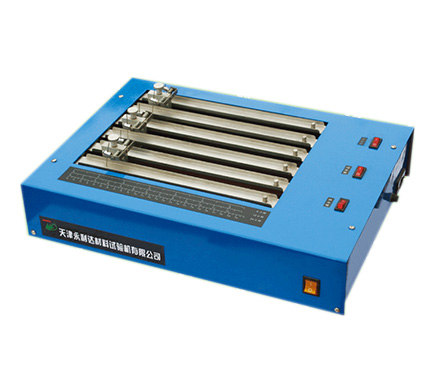
After the topcoat is sprayed, it cannot be heated and dried immediately. It needs a certain period of time. After the solvent has evaporated to a certain extent, it must be heated and forced to dry, otherwise pores will inevitably appear. Obviously, the length of the interval will have an impact on the quality of the coating film and the speed of operation. The setting of the interval time should be as short as possible without generating air holes.
Figure 4-2-149. illustrates the relationship between the interval time and the generation of pores. This figure is the result obtained under the same heating curve and other coating conditions, only changing the interval time. It can be seen from the figure that when the interval time is 5 minutes, even a thin coating film has many pores; when the interval time is between 10min and 1h, there is almost no difference in the occurrence of pores; The time is as long as 16 hours. In this case, even if the coating film is very thick, pores are not easy to appear. (Related instrument: drying time Tester)

The above phenomenon is mainly related to the amount of solvent contained in the coating film. Figure 4-2-149 shows the relationship between the volatilization amount of the solvent and time after painting. In the first 10 minutes, nearly 90% of the solvent volatilizes into the air quickly. If you continue to keep the natural volatilization and drying state, the volatilization speed will be very slow. After about 16 hours, the solvent volatilization amount reached 99%, and compared with 10 minutes after coating, the solvent volatilization amount was not much different. Of course, if a release agent with a slow drying speed is used, compared with 1 hour after painting, there will be a large difference in the amount of solvent volatilization. But in this case, the surface of the former coating film is still in a wet state, and the residual solvent can evaporate outward without hindrance; while the surface of the latter coating film is dry, and it is in a state where pores are easily formed when the residual solvent evaporates outward. The two cancel out and the probability of porosity is at roughly the same level.
In fact, only coatings with small molecular clusters in the coating state, such as baking varnish, acrylic polyurethane, etc., have the above-mentioned solvent evaporation rate characteristics. This characteristic is not applicable to nitro-based coatings. Nitro-based coatings have large molecular groups in the coating state, and if the coating film is thick, the solvent is difficult to volatilize. The evaporation characteristics can be expressed by the lower curve in Figure 4-2-150.
In short, for acrylic polyurethane coatings and baking varnish coatings, the topcoat can be heated and forced to dry within 10 minutes after spraying, and the interval time does not need to be extended. The key in the heating process is to pay attention to controlling the heating rate not to be too fast. To pursue the rationalization of drying operations, we should focus on the heating curve and the relationship between drying temperature and air temperature. It should also be noted that different thinners should be used as the seasons change. (Related instrument: drying time Tester)
As shown by the curve E in Figure 4-2-149, if the topcoat is sprayed in the evening and then forced to dry in the next morning (for about 16 hours), even if the coating film is thick, pores are not easy to appear, which can also be said is a practical approach. However, it should be noted that if it is left overnight, the moisture in the air will often condense into the coating film, which will sometimes cause the coating film to change color.