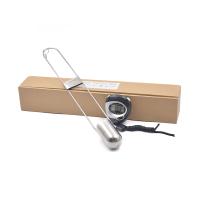
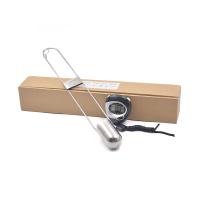
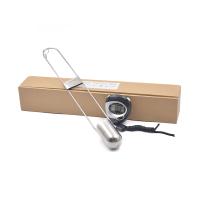
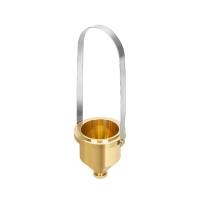
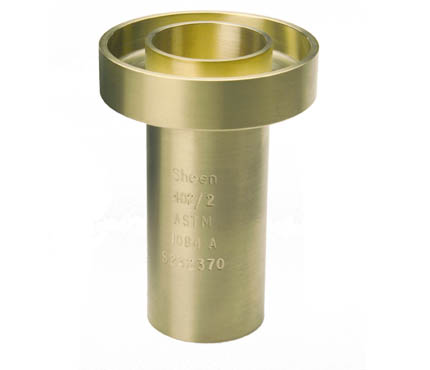
Test principle
The time elapsed from the moment when the material under test starts to flow out from the filled outFlow Cup to the moment when the material flow beam is initially interrupted near the outflow hole is the outflow time of the material under test, expressed in seconds (s). This method is suitable for the determination of fluids with Newtonian flow. This method can be used to control viscosity and is limited to measuring test materials that can accurately determine the breakpoint of the liquid flow flowing out of the outflow hole of the outFlow Cup. Because the outflow time of the Viscosity Cup exceeds 100s, the breakpoint is difficult to determine and the repeatability is poor due to the delay effect.
Operation points
1. Operation preparation
Select an outFlow Cup of a specified number, which should obtain an outflow time of 30s to 100s for the tested sample. Release the finger within 5s of the sample filling the outFlow Cup to measure, and record the outflow time; repeat the measurement, but this time keep the sample in the outFlow Cup for 60s before releasing the finger. If the difference between the second and first results is greater than 10% of their average value, the sample is considered non-Newtonian and therefore not suitable for viscosity determination by this method.
2. Measurement of outflow time
Select the outFlow Cup of a specified number so that it can obtain an outflow time between 20s and 100s for the test sample, and preferably between 30s and 100s. Adjust the temperature of the sample, plug the hole of the outFlow Cup with one finger, pour the sample into the cup, pull the glass plate horizontally across the edge of the outFlow Cup, so that the horizontal plane of the sample and the upper edge of the outFlow Cup are at the same level, measure and record the time, accurate to 0.5s.
3. The result is expressed
The test is repeated twice to calculate the average value of the two measurements. If the difference between the two measurements is greater than 5% of the average value, a third measurement is performed. If the difference between the third measurement value and the previous two measurements is not greater than 5% of the average value, the one measurement value exceeding the requirement is discarded, and the average value of the two acceptable measurements is calculated as the result. If the third measurement still fails to obtain the required measurement value, it is due to the irregular fluidity of the sample that this method is not suitable, and other test methods should be considered.
4. Precautions
The effluent cup should be cleaned with a suitable solvent immediately after use and before the sample begins to dry. Never use metal cleaning tools or wire. If the effluent hole is contaminated with dry sediment, apply a suitable solvent to soften it and wash it carefully, for example by wiping it through the effluent hole with a soft cloth.
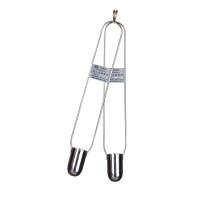
During the test, the thermometer can be inserted into the sample beam, but it cannot interfere with the beam interruption observation. The adjusted temperature difference should not be greater than 0.5 ℃.

本文章由南北潮商城 www.nbchao.com 发布