1 Definition, Purpose and Significance

2 Relevant standards
JG/T 25-1999 Determination of Freeze-Thaw Cycle Resistance of Architectural Coatings
5.12 in GB/T 13492-92 various colors of automotive topcoats
3 Introduction to key points of inspection methods
3.1 Test Principle
Place the test panel at the specified high temperature and low temperature for a certain period of time to observe the change of the coating film.
3.2 Instruments and equipment
3.3 Operation points
3.3.1 JG/T 25-1999 Architectural coating coating freeze-thaw cycle test method
3.3.1.1 Place the test plate in the constant temperature water phase of water temperature (23±2)°C, soak for 18 hours, and the distance between the test plates should not be less than 10mm during soaking.
3.3.1.2 Take out the test plate and place it sideways on the test frame, with the distance between the test frames not less than 10mm. Then, put the test rack with the test piece into the low-temperature box that has been cooled to (-20±2)°C in advance, and freeze it for 3 hours since the temperature in the box reaches -18°C.
3.3.1,3 Take out the test panel from the low-temperature oven, put it into an oven at (50±2)℃ immediately, and keep the temperature constant for 3h.
3.3.1.4 The above is one cycle, and the number of cycles shall be carried out according to the product standard.
3.3.1.5 Take out the test plate and place it under the conditions specified in 2 for 2h. Then, check whether the coating of the test plate has powdering, cracking, peeling, blistering, etc., and compare the degree of color change and gloss decline with the reserved sample test plate. In each group of tests, at least two test panels without powdering, cracking, peeling, blistering, obvious discoloration, etc. are qualified. If the coating is damaged due to substrate opening and other reasons, this group of tests needs to be repeated.
3.3.2 5.12 of GB/T 13492-92 various colors of automotive topcoats
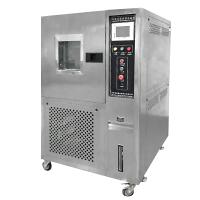
Put the test plate into the Incubator at (90+2)°C for 240h. After taking it out and standing it at room temperature for 0.5h, put it in a low temperature box at (-20±2)°C for 24h, then take it out and leave it at room temperature for 0.5h, then test the 2mm cross-cut test. (Related instruments: constant temperature and humidity Test Chamber)
4 Factors affecting the temperature resistance of paint film
4.1 Substrate: Asbestos cement board is selected as the substrate, and special attention should be paid to the acidity, alkalinity and density of the substrate.
4.2 Preparation of paint film: Due to the unreasonable preparation process, the paint film will produce air bubbles, shrinkage cavities and other pathological conditions, which will affect the temperature resistance of the paint film. The uneven thickness of the paint film will also affect the temperature change resistance of the paint film. (Related instrument: Wet Film Applicator)
4.3 Drying process: Unsuitable drying conditions and insufficient drying time will have a great impact on the temperature resistance of the paint film. (Related instrument: drying time Tester)
4.4 Test water quality: The test water does not meet the requirements of third-grade water, and some users are not suitable to use tap water or pure water as test water.