1 Definition, Purpose and Significance
The moisture and heat resistance of the paint film refers to the resistance of the rattan film to the outdoor high temperature and high humidity environment. When the ambient temperature is high, humid air and saturated water vapor will damage the substrate protected by the coating. The damage mechanism is mainly: when the water penetrates the paint film and reaches the metal substrate, it will generate electricity to the substrate. chemical corrosion. At the same time, the paint film itself will swell after absorbing part of the water, which reduces the adhesion between the paint film and the substrate. (Related instrument: Adhesion Tester) When high temperature and high humidity coexist, the speed of water vapor diffusing into the paint film will be significantly accelerated, which will easily cause blistering and rusting of the painted film. , peeling, discoloration and other damage phenomena. The heat and humidity resistance test of the paint film is also a common corrosion resistance test, which is generally carried out at the same time as the aging resistance and salt spray resistance tests. Recently, it is still widely used in the pretreatment of substrates, corrosion resistance evaluation and comparative tests of coating systems or their combinations.
2 related standards
GB/T1740-79(89) Determination of resistance to heat and humidity of paint film
3 Inspection method introduction
3.1 Test principle
Due to the consideration of uncontrollable outdoor uncertain factors and the need to shorten the test time, many industrial product standards have adopted the test method of hygrothermal resistance of paint film to simulate the outdoor high temperature and high humidity environment to evaluate the hygrothermal corrosion resistance of paint film. The purpose is to simulate the high-temperature, high-humidity and high-corrosion-sensitive environment in nature in the laboratory, and to evaluate the high-temperature and high-humidity resistance of the paint film by observing the samples during and after the test.
3.2 Test equipment
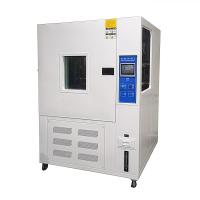
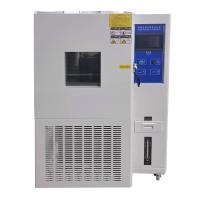
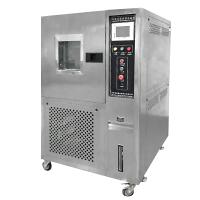
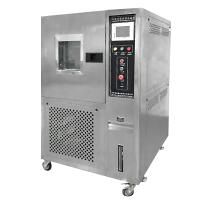
At present, the temperature and humidity control chamber is commonly used at home and abroad to carry out the heat and humidity resistance test. The equipment is generally composed of solution bottle, heating storage tank, humidifier, temperature, hygrometer and controller, test box and pipeline, test plate rack and so on. When the test solution is injected into the heating storage tank for preheating, it is sprayed into the humidifier by the water pump and then blown into the Test Chamber with adjustable temperature and humidity by the fan, forming a constant temperature and humidity environment in the chamber. (Related instruments: constant temperature and humidity Test Chamber)
3.3 Operation points
3.3.1 Test conditions
Chamber temperature: (47±1)℃, relative humidity: (96t2)%, test water: at least meet GB6682 level 3 water.
3.3.2 Preparation, maintenance and pretreatment of samples
The selection, treatment, preparation method, and curing time of the sample substrate for the heat and humidity resistance test generally have corresponding requirements in the relevant product standards, and can also be negotiated by the entrusting test party and the inspection agency. You can also refer to the provisions in GB/T1765-89 "Determination of Humidity and Heat Resistance, High Salt Resistance, Weather Resistance (Artificial Acceleration) Paint Film Production Methods" to prepare and maintain the model. The back and periphery of the panel to be tested can be coated with the sample to be tested or a coating system known to have better anticorrosion properties.
3.3.3 Commissioning test, test and inspection of sample
When the curing period of the test panel is over, except one of them is set aside as a standard panel, the other three can be put into the test box for testing. The samples should be hung vertically on the sample support, no contact between the samples and between the samples and the box, no stacking of the samples, no condensation on the surface of the samples during the test. After each inspection of the sample, the position of the sample on the test plate rack should be changed, such as the exchange of the front row, middle row and rear row.
The test time can refer to the provisions of the relevant product standards or the agreement between the entrusting test party and the inspection agency that a measure of destruction is the end point of the test, such as: the degree and grade of blistering, rusting, and peeling, etc. The common test time is a multiple of 24h, check the sample every 48h during the continuous test, and check every 72h after the first inspection. When inspecting the sample, the test sample can be taken out of the box and compared with the standard plate under sufficient light or light, and the damage of the test sample, such as blistering, rust, falling off, and discoloration, can be judged according to the provisions of the GB/T1766-1995 standard. degree and level. No assessment will be made within 5mm around the periphery of the sample and the hole, and the final result shall be based on the two of the three test panels with the same grade.
3.4 Factors Affecting the Results of Humidity and Heat Resistance Test
3.4.1 During sample inspection, fingerprints should be avoided on the surface of the sample to avoid accelerated corrosion.
3.4.2 The stacking of the test samples will cause the water droplets on the upper sample to fall on the lower sample, which will affect the test results.
3.4.3 If the samples are placed too crowded, it is easy to cause contact between the samples and the box, which may cause electric shock and poor gas circulation inside the box.
3.4.4 The damage or failure of the heat insulation layer of the test box will cause the temperature difference between the inside and outside of the box, resulting in condensed water dripping on the top of the box and falling on the test sample plate, resulting in test errors.
3.4.5 The time for inspecting the sample should be shortened as much as possible (≤0,5h), too long will affect the test results.