This standard applies to the determination of paint film adhesion. The fastness of the paint film to the substrate, that is, the adhesion, is evaluated according to the completeness of the paint film within the scratch range of the circular rolling line, expressed in grades.
1. General provisions
Materials and equipment:
tin plate: 50x 100x0.2-0.3 mm;
four times magnifying glass;
paint brush: 25-35 mm wide;
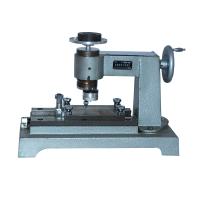
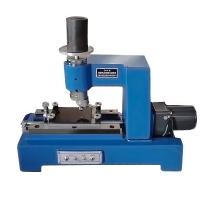
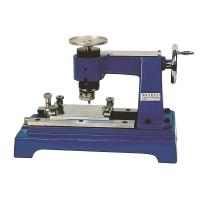
adhesion Tester: as shown in Figure 1.

The specifications of the relevant parts of the adhesion Tester:
the screw (9) of the test bench has a pitch of 1.5mm, and its rotation is synchronized with the rotating needle
;
Brick code, its weight is 100, 200, 500, 1000 grams;
the turning radius of the rotary needle is adjustable, and the standard turning radius is 5.25mm.
2. Determination method
According to the "General Preparation Method of Paint Film" (GB 1727-79), prepare 3 samples on the tin plate (or the substrate specified in the product standard), and measure it under the conditions of constant temperature and humidity after the paint film is completely dry. Check the needle of the adhesion Tester before testing, if it is not sharp, it should be replaced: lift the half nut (7), pull out the test stand (6), and then change the needle. When the scratches are found to be inconsistent with the standard radius of gyration, the radius of gyration should be adjusted. The method is to loosen the bolts behind the needle plate (3) and the adjusting bolt (4) for the radius of gyration, and after moving the needle plate appropriately, tighten the above If the bolts and scratches are compared with the standard circular roll line diagram, if they still do not match, the radius of gyration should be readjusted until it is the same as the standard circular roll line with a 5.25mm radius of gyration. When measuring, place the sample on the test bench (6), tighten the adjusting bolts (5), (8) and adjusting bolts (10) to fix the sample, and move the lifting rod (2) backward to make the tip of the rotating needle touch If the paint film is not exposed, if the scratches do not reveal the bottom plate, enamel should be added accordingly. Clockwise, shake the rocking handle (11) evenly, and the rotating speed is advisable with 80-100 revolutions, and the standard pattern length of the circular rolling line scratches is 7.5 ± 0.5 centimeters. Move the elevating bar (2) forward to lift up the pin plate, loosen the relevant bolts (5) and (8?. A magnifying glass inspects for scratches and grades them.
3. Rating method
Take the upper side of the scratches on the sample as the target of inspection, and mark seven parts such as 1, 2, 3, 4, 5, 6, and 7 in turn. Correspondingly divided into seven levels. Check the completeness of the paint film of each part in order. If more than 70% of the lattice of a certain part is intact, it is considered that the part is intact, otherwise it should be considered damaged. For example, if the paint film of part 1 is intact and the adhesion is very good, it is rated as the first grade; if the paint film of part 1 is damaged and the part 2 is intact, the adhesion is next, and it is rated as the second grade. And so on, grade seven is the worst adhesion. ·
The standard scratched round rolling line is shown in Figure 2.

The result is subject to the same level of at least two samples.
Note: From the date of implementation of this standard, the original standard HG2-462-78 becomes invalid.