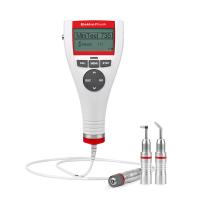
There are two different methods of measuring dry film thickness, which are divided into:
① Destructive testing;
② non-destructive testing.
The destructive test method requires scratching and other damaging actions on the paint film, while the non-destructive test method will not cause damage to the paint film. Three types of non-destructive testing instruments are introduced below
(1) Magnetic Thickness Gauge (banana type)
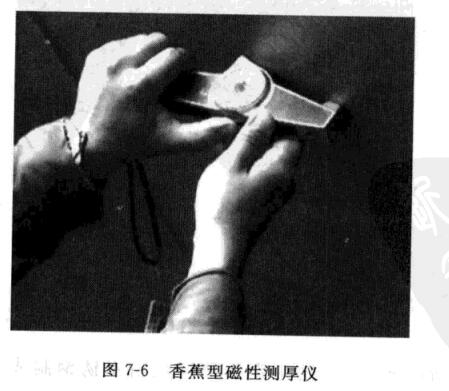
The banana-type magnetic Thickness Gauge (Figure 7-6) is the easiest to use, because it looks like a banana, so it is usually called a banana-type Thickness Gauge. Magnetic Thickness Gauges can only be used to measure the thickness of coatings on steel surfaces. On the sensor head, there is a permanent magnet. The Thickness Gauge is placed on the coating on the surface of the steel plate. The roller in the middle is turned towards the operator until the magnetic head is lifted from the paint film. At this time, it can be read from the scale. Paint film thickness. The error of the magnetic Thickness Gauge is allowed within -1-5%.
(2) Electronic Thickness Gauge
Electronic Thickness Gauges have been used for a long time. There are single probes and double probes, and the error is within ± 3%. If the measurement range is adjusted, the error can be controlled within ± 1%. The electronic Thickness Gauge measures the paint film thickness through the magnetic flow between the probe and the substrate. It runs on batteries and requires frequent adjustments. The reading of the Thickness Gauge can be accurate to o.1µm.
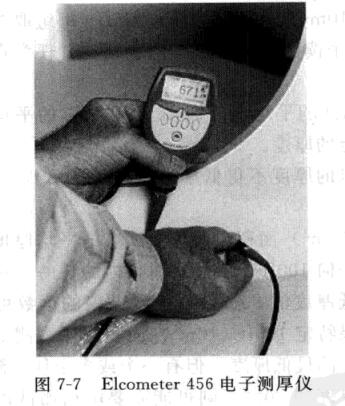
The widely used electronic Thickness Gauges are Elcometer345 and 456 series, and the measuring range is within 1500µm. Elcometer456 Electronic Thickness Gauge (Figure 7-7) adopts menu control method and has powerful functions. You can download the supporting software from the website, and analyze the paint film in the computer through the data line. By exchanging different probes, it can be applied to a variety of metal or non-metal substrates, and it is suitable for measuring coating thickness on flat and curved surfaces.
(3) Thickness gauge with eddy current principle
This type of Thickness Gauge is used on non-magnetic metal substrates, such as aluminum, stainless steel, etc. A small amount of eddy current from the probe is transmitted to the metal substrate through the paint film, and then the thickness of the paint film can be known.