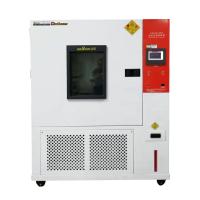
Wheel hubs are an important part of a car, so their reliability and durability under various environmental conditions need to be ensured. The high-low Temperature Test Chamber can simulate the extreme temperature environment to test the physical and chemical properties of the wheel hub at high-low temperatures.
High temperature test:
Expose the hub to a high temperature environment, typically 100°C to 180°C, for hours to days. At this time, the material and structure of the hub will be affected by high temperature, and whether it can withstand the influence of high temperature environment is tested to evaluate its reliability and performance in high temperature environment.
Low temperature test:
Expose the hub to a low temperature environment, typically -40°C to -20°C, for hours to days. At this time, the material and structure of the hub will be affected by the low temperature. It is tested whether it can withstand the influence of the low temperature environment to evaluate its reliability and performance in the low temperature environment.
Temperature cycle test:
Place the hub alternately in high-low temperature environments to test its stability and tolerance under different temperature changes, so as to simulate the temperature changes in the actual use environment.
These tests can help wheel hub manufacturers and users evaluate the performance and reliability of the wheel hub to ensure that it can work stably and for a long time in actual use. In addition, these tests also help to optimize the wheel material and structural design, and improve the durability and safety of the wheel.

experiment procedure:
Put the hub into the high-low Temperature Test Chamber, and make sure there is enough space between the hub and the Test Chamber so that the air can flow freely.
Set up the chamber to the desired temperature and humidity conditions and allow it to reach steady state.
The hub is exposed to high temperature conditions for a period of time, usually several hours, to simulate the conditions of use in a high temperature environment. The hub is then placed in cold conditions for the same amount of time.
At each temperature condition, check the physical properties of the hub, such as strength and shape. Also check for any chemical changes or damage to the hub surface.
Repeat the above steps until the test is complete.
*In the high-low temperature test, other test methods can also be used, such as thermal cycle test or expansion coefficient test, to evaluate the performance of the hub under the change of temperature.