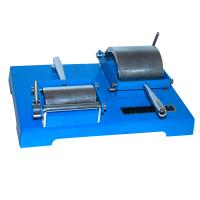
There are different measurement methods for the flexibility (for protective and decorative coatings) and elasticity (for electrical insulation coatings) of coating films, which are introduced as follows.

(1) Determination of flexibility
This method is applicable to the determination of the flexibility of the coating film, and it is expressed by the diameter of the smallest mandrel that the sample bends on mandrels of different diameters without causing damage to the coating.
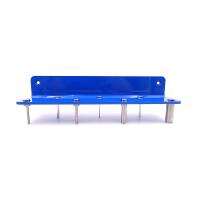
① Equipment Flexibility Tester, see Figure 6-4. It is composed of 7 steel shaft rods with different thicknesses, fixed on the base, and the base can be fixed on the test bench with intermediary nails
side.
The dimensions of the shaft rods are as follows: the length of each shaft rod is 35mm;
Shaft 1: the diameter is 15mm;
Shaft 2: the diameter is 10mm;
Shaft 3: cut to 5mmX10mm, the radius of curvature is 2.5mm;
Shaft 4: section 4mmX10mm, radius of curvature 2mm;
Shaft 5: section 5mmx10mm, radius of curvature 1.5mm;
Shaft rod 6: section 2mmX10mm, radius lmrn;
Shaft 7: section lmmX10mm, radius of curvature is 0.5mm.
1 x 4x magnifying glass.
② Samples See Table 6-2 for samples.
③Determination method Test under the test conditions of (23±2)℃ and relative humidity of 50%±5%. Press the sample tightly with both hands on the pumping rod with a specified diameter according to the product standard, and bend it around the rod. When bending, the thumbs of both hands should be symmetrical to the center line of the sub-axis rod, and the bending action needs to be completed within 2~3s. After the coating film is bent, observe it with a 4 times magnifying glass. If there are cracks and peeling off, it is unqualified. (Related Instrument: Adhesion Tester)
(2) Determination of Elasticity/Bending Cracking
This test is used to determine whether electrical insulating coatings crack after bending.
a. See Appendix III for each setting.
b. The sample is made of cable copper with a cutting surface size of (4.5±0.2)mmX(13.5i0.2)mm, four corners R=1mm, a length of 250mm, and a coating thickness of 0.4~0.45mm. 2 pieces. (Related Instruments: Thickness Gauge)
c. Test method Soak the sample in water at (2o±2)°C for no less than 20 minutes, take it out and put it in the jacket after the temperature stabilizes, and use a curved wrench (the shortest distance between the wrench and the central jacket is 10mm) to hold the sample Bending to 115°, each specimen is bent at 5 points.