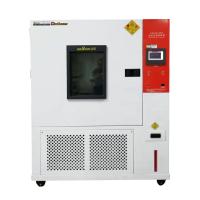
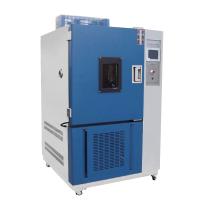
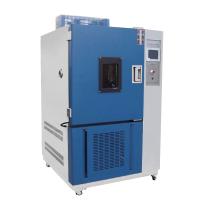
Optical lens is a high-precision optical component, mainly used in cameras, telescopes, microscopes and other fields. Optical lenses may change under different temperature environments, such as expansion, shrinkage, deformation, cracking, etc. Therefore, high-low temperature tests are required to test their tolerance. In high temperature environments, optical lenses may deform or lose their optical properties, while in low temperature environments, optical lenses may become brittle or crack. In order to ensure the stability and performance of optical lenses at different temperatures, high-low temperature tests are required. The high-low Temperature Test Chamber can simulate conditions under different temperature environments, and test optical lenses to evaluate their performance at different temperatures.

experiment procedure
1. Place the optical lens to be tested in a high-low temperature test box, and set the temperature of the box to the temperature to be tested.
2. Open the high-low temperature test box, adjust the temperature controller to the temperature to be tested, and wait for the temperature inside the box to reach a stable state.
3. After the temperature in the box is stabilized, keep the optical lens at the temperature to be tested for a period of time, usually ranging from several hours to several days, to observe its stability and performance.
4. After completing the heat preservation test, gradually increase or decrease the temperature of the box to simulate the performance of optical lenses under temperature changes.
5. For optical lenses that need to simulate multiple temperature environments, multiple temperature cycle tests can be performed to simulate the stability and performance in different environments.
6. During the test, it is necessary to record the performance of the optical lens at different temperatures, such as transmittance, reflectivity, distortion and other parameters, so as to facilitate subsequent data analysis and comparison.
Through the above steps, the performance of the optical lens under different temperature environments can be evaluated, and optimized and improved according to the test results to improve its stability and reliability.