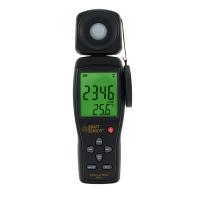
Grading photometer (as shown in the picture)  , the optical components of this photometer are installed on the monocular telescope at an indeterminate distance, and there are two objective lenses 1 and 2 inside the telescope, and the light beam to be compared passes through these two The lens is involved in the telescope. The distance between the two lens axes is 70mm. The light beam passes through the prisms 3 and 4 and the double prism 5. After passing through the small magnifying glass on the eyepiece 6 of the device, the images of the light beams 7 and 8 covered by each other can be clearly seen. This is called the exit pupil.
If you look through an eyepiece without a magnifying glass, you can see two semicircles divided by a thin line. Other things being equal, the relative brightness of the semicircle depends only on the ratio of the areas of the two beams.
Color (including white and black) measurements are made using transmit and reject filters. When the light-transmitting filter is applied, the luminosity of the sample 9 is compared with the standard measuring plate 10, and the chromaticity of the black color contained in the sample can be obtained. When using the blocking filter, the chromaticity including white color can be measured in the same way.
The device nested with various filters is placed in front of the eyepiece of the photometer, and there are a total of 7 filters (seven colors) in the instrument. Colors containing white have the smallest characteristic and spectral curve (in the darkest part of the spectrum), so if the color contains white, it is necessary to apply the filter with the smallest measurement value (retention filter) for measurement. The feature containing black has the largest spectral curve, so it needs to be measured with the filter (light transmission filter) with the largest measured value.
Chromatic colors can also be measured using a grading photometer.