For various liquid substances, especially chemically pure compounds, specific gravity is an important constant. Every chemically pure compound has a certain specific gravity at a certain temperature. The determination of specific gravity has special significance when testing the purity of various solvents and oils in the paint industry.
However, for paint materials such as oil-based varnishes, their specific gravity cannot be used as a constant that can indicate their performance. In this case, the specific gravity can only be used as a temporary provision for the uniformity (standardization) of a certain brand of paint. However, since the specific gravity of any varnish can vary widely with raw materials and manufacturing procedures, determination of it becomes unnecessary. The determination of specific gravity has special significance in determining the weight of paint consumption, changing from volume unit to weight unit, determining the operating procedures of the dipping bath and other aspects.
For example, the weight of paint consumed depends on the value of its specific gravity, and if the thickness of the paint layer is uniform, the greater the specific gravity of the paint, the greater the weight of paint consumed per unit surface. Therefore, under the condition that other conditions are equal, the specific gravity of the paint can save the amount of paint.
Specific gravity is of great significance for evaluating the performance of printing inks. Heavy inks can cause some complications when printing, especially at high speeds (on rotary machines), because the uniformity of high specific gravity inks is destroyed more quickly.
We all know that the weight per unit volume of an object is called specific gravity. It is usually obtained by comparing the weight of an object at 20°C with the weight of the same volume of water at 4°C. In this case the specific gravity is indicated by the d 4 20 notation.
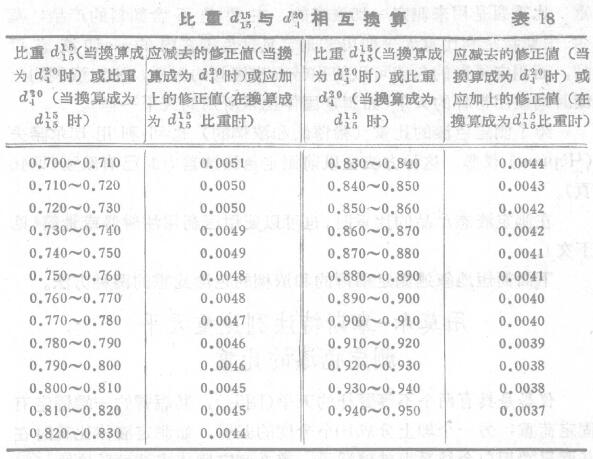
If using an instrument carved at t=+15°C and corresponding to the density of water at f==15°C, it can be converted to the specific gravity of d 4 20 according to Table 18 .
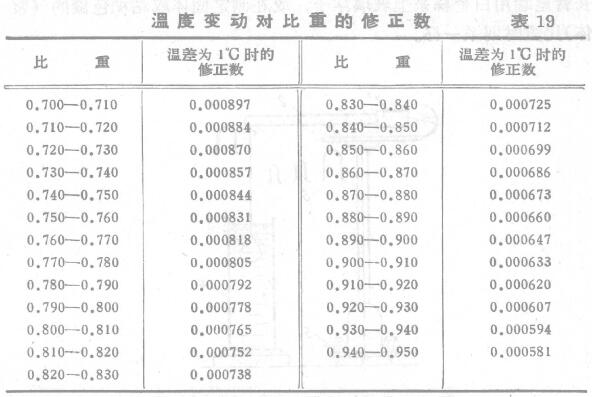
If the specific gravity is not measured at t=+20°C, it can be converted to the specific gravity at t=+20°C using Table 19.
The choice of specific gravity determination method should be determined according to the test solution used and the required accuracy.
It is recommended to use a pycnometer for measurement that requires very accurate measurement, but it is difficult to use a pycnometer for very thick samples.
Determining the specific gravity of paint materials usually uses a hydrometer, a pycnometer or a Mohr- Westfali specific gravity balance.
The hydrometer is used to determine the specific gravity of all liquid products that do not produce sediment when diluted; the pycnometer is used to measure all liquids, mainly products that do not contain pigments; Determination of all liquid products including paints, while measuring thin paints can use a balance with a submerged tube, when measuring thick paints, use a balance with a cup (like the balance used to determine the specific gravity of solids).
In order to determine the specific gravity of paint (thin and thick) can also use Chernoff instrument. This method has been described in the previous determination of the hiding power of the paint.
