The oil absorption suitable for construction consistency can be understood as the amount of oil (binder) in the paint when the paint reaches a consistency that is convenient for construction on the surface to be coated. The paint should be easy to apply, and should not be too thin, and should not flow on the vertical plane. (Related instruments: Sag Tester)
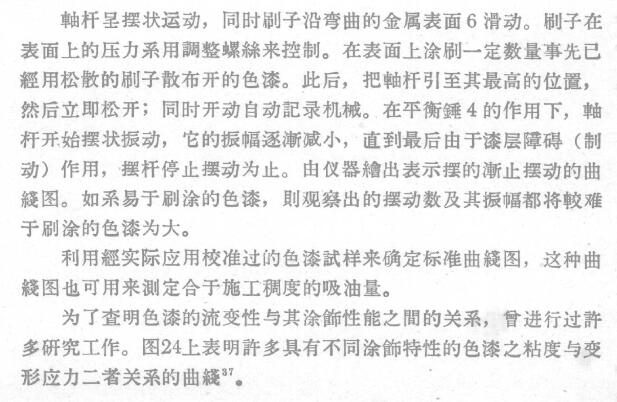
In solvent-free oil-based paints, the ease of application and flattening of the paint is determined by its thixotropy, which is the mechanical force (knocking, pressure, brush movement, etc.) Under the action of ), it becomes diluted and has fluidity, and when the force is removed, it returns to the performance of a thick state. (Related instrument: leveling meter)
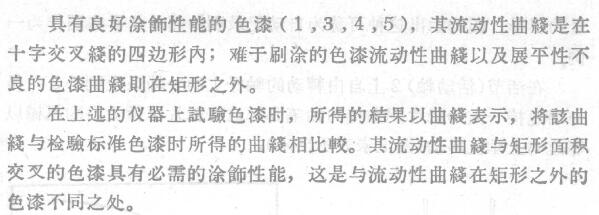
Thixotropic thickening is caused by cohesion of pigment particles. In the static state, the structure formed by the cohesion of pigment particles is caused by the loss of fluidity of the paint. In order to regain the fluidity of the paint, it is necessary to use mechanical force to destroy this structure (even a part). Therefore, the ease of painting and its flattening of the paint depend on the stability of this structure, and on the speed at which the damaged structure recovers after the deformation stress is removed. For example, a brush paint (brush paint means a paint suitable for finishing with a paintbrush) will be easy to apply if it has little shear strength, because in this case, even when moving Significant structural damage will occur under the small deformation stress induced by the paint brush. The flatness is determined by the time required to restore its structure. When the structure is restored particularly quickly, brush marks will be left on the coating, which will become obvious strands. Coatings applied with a paint sprayer, in which case an orange peel condition or other similar pathological conditions may develop.
When the recovery of the structure is very slow, the phenomenon of paint flowing down from the vertical surface occurs. The best flatness (flatness) of the paint is compatible with a certain optimum time for the restoration of the damaged structure in the paint.
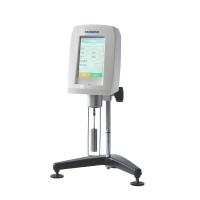
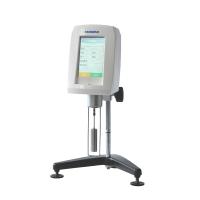
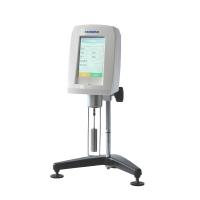
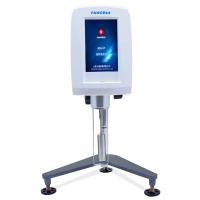
The factors that determine the flatness of solvent-free oil-based paints are: the original colloidal properties of the components in the system that can affect the pigment particle cohesion process, and the quantitative ratio between pigment and binder. When the paint contains a solvent, the volatility of the solvent is an additional factor affecting the flattening, because the solvent evaporates rapidly from the coating, which causes the viscosity of the paint material to increase prematurely, thus causing difficulties in flattening. (Related instrument: viscometer)
The necessary dilution of the paint (consistency suitable for painting or construction) can be determined by test (tested by the painter during the construction process).
Our standard method of determining a suitable consistency for application based on the initial diffusion of 'brush strands' is only applicable when the adhesive is a natural cooked oil. As with all other adhesives, This method is not applicable.
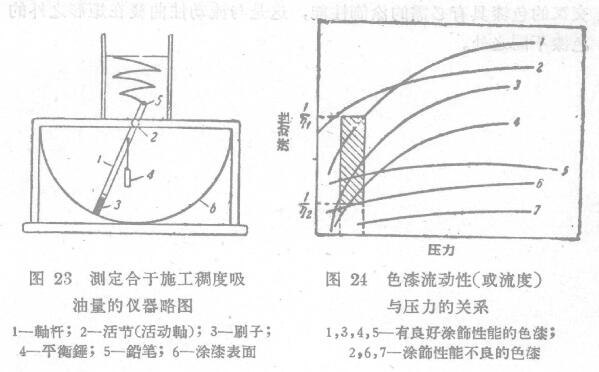
In Document 6, it is described that there is a device that can accurately measure the oil absorption suitable for the construction consistency. Figure 23 shows as an example a schematic diagram of such a simple instrument, which may be called an automatic recording brush.
One end of the axle bar 1 that rotates freely on the joint (movable shaft) 2 is tied with a brush 3; This piece of paper can be moved vertically upwards at a constant speed by suitable machinery (not shown in the figure).