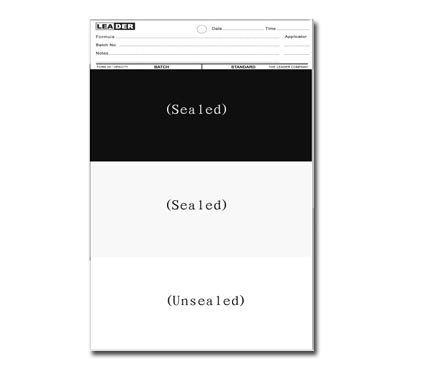
One method for testing the lightfastness of pigments is based on the use of natural light, while the other is based on the use of artificial light. When testing the lightfastness of pigments under natural light, the tested pigments are generally ground together with an oil-based adhesive or glue solution. But for this purpose, it is recommended to use pure gelatin. The lacquer is applied to iron plates and wooden boards, and then half of the lacquered boards are covered with pieces of paper or shelves. After a certain period of exposure, compare the colors of the two halves of the test plate (covered and uncovered). (Related Instruments: Concealment Paper)
Of course, this measurement is very subjective and inaccurate, because the effect of sunlight is not taken into account when performing this test in the first place. Secondly, in addition to light, there are also auxiliary factors: water, dust, etc., also affect the color of the paint, so it is difficult to determine what effect light plays on the change of pigment. In order to eliminate the influence of some auxiliary factors, the test plate is sometimes spread out indoors so that the painted side faces the sun.
The solar hours can be measured by multiplying the "daylight scale", which is made of blue paper coated with an organic dye. The blue paper is illuminated with light, and the paint layer is irradiated at the same time to measure the number of solar hours that the paint layer is subjected to light. (Related Instruments: Lux Meter)
In strict accordance with all the meticulous rules of this method, this method yields good results.
To prepare blue paper, 200 grams of kaolin are mixed with 200 milliliters of water, and then 400 milliliters of solution is added to this mixture, which is made by dissolving 2 grams of alkaline blue dye in 1000 milliliters of water. The sediment is then filtered out.,:Crushed in a dry well in a dark room at room temperature. After that, 50 grams of the prepared pigment is stirred into 35 ml of water, and then 400 ml of clear glue solution (1:5) is added, and the mixture is carefully stirred, brushed on the slightly torn paper, and dried in the dark. When the paper is exposed to the sun, it gradually fades. Every half hour, a piece of paper is cut out of the paper to create a "daylight scale" composed of a series of pieces of paper of different colors.
In recent years, in the determination of the lightfastness of pigments, the lightfastness standard of fabrics has been adopted.
The small strips of woolen fabrics coated with different lightfastness coated with organic dyes are used as the lightfastness standard of fabrics; These strips are the standard of lightfastness (light fastness). It should be noted that, although the fabric standards only stipulate the fading standard, but not the color darkening and color light change standard, they can often indicate the lightfastness of pigments and ordinary pigment paint films, especially those color paint films that contain a mixture of organic pigments and inorganic pigments.
In order to test the lightfastness of the pigment, the corresponding color paint film can be placed in the sun (under natural light) and then the color changes over time. In the Soviet Union, in order to determine the stability of organic dyes to light, a criterion divided into five stability classes was used. This standard is made of "record" brand wool fabric, which is dyed from various dyes according to a special formula.