Overview
Temperature shock test is a test method to test the performance stability of a product under extreme temperature changes. The test evaluates the reliability and durability of the product under these conditions by placing the tested product in a high temperature and low temperature environment for cyclic changes to simulate the extreme temperature conditions that the product may encounter in the real environment.
In the temperature shock test, the tested product will be placed in a high temperature environment for a period of time, then quickly move to a low temperature environment, and cycle back and forth many times. This rapid temperature change can cause thermal expansion and contraction of the product material, which can cause changes in internal stress, and test the durability and reliability of the product under such changes.
Temperature shock testing is widely used in electronic products, auto parts, aerospace equipment and other fields. This test method can help manufacturers evaluate the reliability and durability of products under extreme temperature changes, thereby improving product design and manufacturing processes, and improving product quality and performance.

Test principle
The principle of temperature shock testing is to simulate the extreme temperature conditions that a product may experience in the real world by exposing the sample to a high-low temperature environment. This rapid temperature change causes the sample material to undergo thermal expansion and contraction, which creates stress inside the material and changes its structure and properties. By continuously cycling the temperature, the durability and reliability of the sample under the action of thermal expansion and contraction can be tested.
The temperature shock test usually adopts two different methods, namely vertical and horizontal. The vertical temperature shock test places the sample in an airtight Test Chamber, where the upper part is the high temperature area and the lower part is the low temperature area. By controlling the temperature change in the high temperature area and the low temperature area, the sample is moved back and forth between high temperature and low temperature. The horizontal temperature shock test places the sample in a double-layer Test Chamber, and the sample is transferred between high temperature and low temperature through a turntable.
Before temperature shock testing, the sample needs to be pretreated and the recovery time before testing. The pretreatment process usually involves heating and cooling under normal conditions to remove stress and strain from the sample and bring it to a stable state. The recovery time before testing is to ensure that the sample has returned to its original temperature and properties before proceeding to the next temperature cycle.
Through temperature shock testing, the reliability and durability of samples under extreme temperature conditions can be evaluated, providing a basis for product design and manufacturing process improvement.
Relevant standards
At present, many organizations and institutions have developed standards related to temperature shock testing. The following are some standards related to temperature shock testing:
IEC 60068-2-14: General provisions for testing of electronic equipment, Part 2-14: Temperature cycle test (temperature shock test)
MIL-STD-883G: Test Method Standard, Microelectronic Devices, Section 1010.8: Temperature Shock Test
JIS C 60068-2-14: General provisions for testing of electronic equipment, Part 2-14: Temperature cycle test (temperature shock test)
GB/T 2423.22-2012: Testing of electronic products - Part 2: Test methods (temperature cycle test)
ASTM D7439-08: Assessing the Properties of Polymer Materials by Temperature Cycle Testing
These standards usually specify the test procedures, temperature variation range, test time, number of cycles, etc. of the temperature shock test to ensure the reliability and consistency of the test results. According to the application field and requirements of the product, manufacturers can choose the temperature shock test method that meets the corresponding standards for testing.
Test equipment
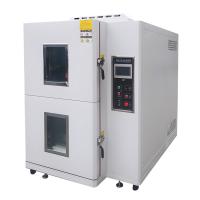
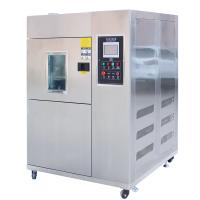
Temperature shock testing requires the use of specialized test equipment, often referred to as a temperature shock Test Chamber or temperature cycle Test Chamber. These devices can simulate high-low temperature environments and perform temperature shock testing by controlling the transfer of samples between high-low temperatures.
A temperature shock Test Chamber usually consists of a closed laboratory with high temperature and low temperature zones inside. High temperature and low temperature zones are usually controlled by independent temperature control systems to ensure that they can quickly reach the set temperature in a very short time and can accurately maintain a stable temperature.
During temperature shock testing, the sample is usually placed in a sample tank that can be moved between the high temperature and low temperature regions. By controlling the transfer of the sample tank between high temperature and low temperature, the thermal expansion and contraction of the sample under extreme temperature conditions can be simulated.
Some high-end temperature shock test equipment can also be equipped with a data collection system to record the temperature change and performance change of the sample in real time, so as to more accurately evaluate the performance and reliability of the sample at different temperatures.

How to operate
To test the impact resistance of electronic components, the following steps can be used:
Prepare test equipment: Use a temperature shock Test Chamber or a temperature cycle Test Chamber as test equipment. Set the temperature range and temperature change time of high temperature and low temperature according to the specifications and requirements of the components.
Mounting components: The components to be tested are installed in the sample tank, making sure they are in place and connecting them to the data collection system of the test equipment.
Start the test: Start the test equipment and move the sample tank between high-low temperatures to simulate temperature shock. Depending on the needs, different temperature change times and cycle times can be set.
Observe and record: Observe the performance of components during testing, and record their temperature changes and performance changes. A data collection system can be used to record electrical parameters of components at different temperatures, such as resistance, capacitance, etc.
Analysis results: Analyze the impact resistance of the component according to the test results, and evaluate whether it meets the specifications and requirements. If the component fails the test, further improvements and optimizations are required to improve its impact resistance.
It should be noted that when testing the impact resistance of electronic components, the characteristics and requirements of the components should be considered, and appropriate test methods and test parameters should be selected according to the actual situation. At the same time, the corresponding standards and specifications should be followed during the test process to ensure the reliability and consistency of the test results.