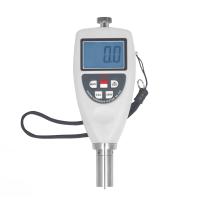
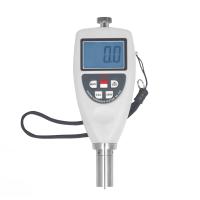
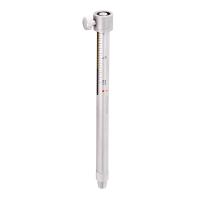
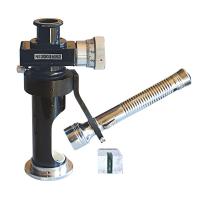
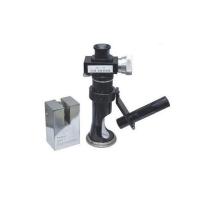
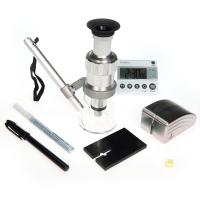
The Buchholz indentation Tester, also known as the Buchholz Hardness Tester or simply the Buchholz Tester, is a type of hardness testing instrument used to measure the hardness or indentation resistance of materials, especially polymers, rubbers, and elastomers. It is named after its inventor, Dr. Friedrich Buchholz, who developed the Tester in the early 20th century.
The Buchholz indentation Tester works on the principle of measuring the depth of indentation produced by a standard indenter under a specific load on the surface of a material. The indenter, typically a steel ball or a spherical-tipped diamond, is pressed into the material surface with a predetermined force for a specific time, and the resulting indentation depth is measured or compared to a reference scale to determine the material's hardness.
The basic components of a Buchholz indentation Tester typically include a test head or a test station with a fixed indenter, a load application system, and a measuring or reading system. The load application system may consist of a lever arm, a weight, or a hydraulic or pneumatic system that applies a constant load to the indenter during the test. The measuring or reading system may involve a depth gauge, a microscope, or other devices that measure the indentation depth or diameter, which is then used to calculate the material's hardness using specific formulas or conversion tables.

The specific steps for conducting a hardness test using a Buchholz indentation Tester may vary depending on the specific model and manufacturer, as well as the material being tested. However, the general procedure typically involves the following steps:
Ensure that the Buchholz indentation Tester is properly calibrated and set up according to the manufacturer's instructions. This may involve verifying the accuracy of the load application system, checking the alignment of the indenter, and calibrating the measuring or reading system.
Prepare the material sample to be tested according to the specific requirements of the test. This may involve cutting or shaping the material into an appropriate shape and size, ensuring that the surface is clean, smooth, and free of debris or contaminants.
Place the prepared material sample on the test station of the Buchholz indentation Tester, and position the indenter over the sample surface. Apply a predetermined load or force to the indenter using the load application system, and maintain it for a specific duration, typically a few seconds to a few minutes, depending on the material being tested.
After the load is applied, release the load gradually or remove it completely, allowing the indenter to penetrate the material surface and create an indentation. The indentation depth or diameter is typically measured immediately after the load is released or at a specified time interval.
Measure the indentation depth or diameter using the measuring or reading system of the Buchholz indentation Tester. This may involve using a depth gauge, a microscope, or other devices, depending on the specific Tester model. Record the measurement accurately.
Use the measured indentation depth or diameter to calculate the hardness of the material using specific formulas or conversion tables provided by the manufacturer or standard specifications. The hardness value may be expressed in various units, such as Shore hardness, Rockwell hardness, or Brinell hardness, depending on the specific Tester and material being tested.
Compare the calculated hardness value with the desired hardness range or specified requirements for the material being tested. Evaluate the material's hardness based on the results obtained and interpret them accordingly. Keep in mind that hardness values may vary depending on the specific material, testing conditions, and hardness scale used, so it's important to interpret the results in the context of the specific material and application requirements.
Document the results of the hardness test, including the material tested, the specific test conditions, the hardness value obtained, and any relevant observations or comments. Prepare a test report or record the results in a suitable format for future reference or documentation purposes.

Buchholz indentation Testers are commonly used in the rubber, plastics, and elastomer industries to assess the hardness or indentation resistance of materials in various forms, such as sheets, films, molded parts, and coatings. Hardness is an important mechanical property of materials that can affect their performance, durability, and suitability for specific applications. Different materials and formulations may require different indentation test methods, indenter shapes, sizes, loads, and time durations to accurately measure their hardness, and Buchholz Testers provide a reliable and convenient means for such measurements.