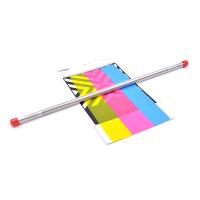
Both squeegee sticks and wet film preparers are tools for applying liquid coatings or films to substrates, but they have some key differences in design and application.
Different manufacturing principles
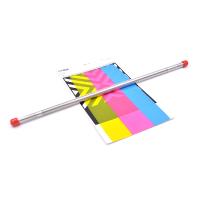
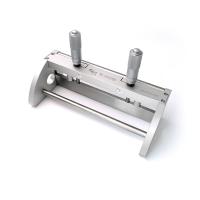
The squeegee rod consists of a cylindrical rod on which the wire is spirally wound to form a spiral pattern. The wire row spacing determines the coating thickness. Wet film preparers, on the other hand, are usually composed of flat, rectangular or wedge-shaped blades made of metal or plastic, with straight or notched edges to control the coating thickness.

Different film thickness control
The squeegee bar provides a controlled and uniform coating thickness by controlling the line spacing between the wire wraps, which determines the amount of coating applied. In contrast, the wet film preparer controls the coating thickness through the gap between the blade and the substrate. The operator adjusts the angle, pressure and speed of the wet film preparer to achieve the desired thickness, but it may not be as accurate as the squeegee bar. And the squeegee bar can prepare a minimum of 1.5 microns of wet film, and the wet film preparer can only prepare a minimum of 10 microns, and the accuracy is not high.
Different scope of application
Scraper sticks are often used in applications where precise control of coating thickness cannot be overstated, such as printing, coatings, adhesives, and electronics, and are often used for thinner coatings or films. Wet film preparers, on the other hand, are more commonly used for thicker coatings or films, and are often used in applications that accept slightly less accurate coating thicknesses, such as architectural, automotive, or marine coatings.
Different functions
Scraper sticks are known for their versatility as it can also be used for other purposes such as coating films, mixing, leveling or coating patterning as it has a wire pattern. On the other hand, wet film preparers are mainly used for coating thickness control.

Applicable viscosity is different
The ink scraper can generally prepare ink coatings below 3000cp, and the mainstream winding rods on the market can prepare 1000cp. When the ink viscosity exceeds this value, a wet film preparer needs to be selected, because it does not require high viscosity.
There are a few other factors to consider when choosing a scraper stick and wet film preparer:
Substrate Type: The type of substrate to be coated can also affect the choice between a squeegee stick and a wet film preparer. Wire wound Meyer sticks are generally better suited for flat or relatively smooth substrates, as the wire may not fit well on irregular or rough surfaces. Film wet preparers have a flat blade design that can be more versatile for coating uneven or textured surfaces.
Coating Material: The type of coating material can also influence the choice of tool. Some coating materials may have specific requirements in terms of application technology or coating thickness control. For example, certain sensitive coatings may require the precise control provided by the squeegee stick to avoid overapplication or damage to the coating. In contrast, other coatings may be more forgiving, allowing for less accurate coating thickness control using a wet film preparer.
Operator Skill Level: The operator's skill level and experience can also be a consideration. Scraper sticks often require more skill and experience to achieve precise and consistent coating thickness, as line-to-line spacing needs to be carefully controlled. Wet film preparers are simpler in design and may be easier to use for operators with less experience or training.
Cost: Cost may also be a factor in the choice between squeegee sticks and wet film preparers. Squeegee sticks are generally more expensive because of their precision winding design, while wet film preparers tend to be more cost-effective because of their simpler design.
To sum up, there are differences between scraping sticks and wet film preparers in terms of design, coating thickness control, application techniques, and application scope. Scraping sticks are known for their precise and uniform coating thickness control and versatility, while wet film preparers are typically used for thicker coatings and may provide slightly less precision in coating thickness control. The choice between the two tools depends on the specific requirements of the coating application and the desired coating thickness control. In conclusion, both scraping sticks and wet film preparers have their unique advantages for different coating applications. The choice between them depends on factors such as desired coating thickness control, substrate type, coating material, operator skill level and cost considerations. Understanding the differences between these tools can help you choose the right tool for a particular coating application to achieve the desired coating quality and performance.