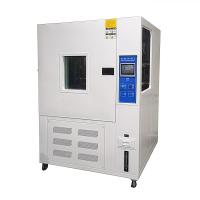
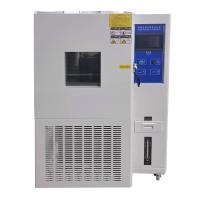
Humidity chambers are widely used in the coatings and adhesives industry to test the performance and durability of coatings and adhesives under high humidity conditions. Exposure to high humidity can cause degradation, delamination, and other forms of damage to coatings and adhesives, which can affect their functionality and lifespan.

In a Humidity Chamber, coatings and adhesives can be exposed to high humidity conditions to simulate the effects of long-term exposure to moisture. The samples can then be evaluated for changes in appearance, adhesion, flexibility, and other properties to determine their resistance to humidity and potential for degradation.
Humidity chambers are also used to evaluate the effectiveness of coatings and adhesives in preventing moisture ingress into a product, such as a building material or electronic component. In these cases, the samples are exposed to high humidity conditions while their performance is monitored to determine whether they are able to effectively prevent moisture ingress.
Overall, Humidity Chambers play a critical role in ensuring the reliability and durability of coatings and adhesives in a range of applications, from construction and automotive to electronics and aerospace.
In the coatings industry, Humidity Chambers are also used to test the curing and drying properties of coatings. The curing process of a coating refers to the process of hardening and solidifying of the coating film. The drying process, on the other hand, refers to the process of solvent evaporation from the coating.
The curing and drying processes are affected by humidity levels and temperature. Humidity chambers allow manufacturers to simulate different humidity and temperature conditions to test the curing and drying properties of coatings, allowing them to optimize the formulations and ensure that the coatings can be used in a range of environments.
Humidity chambers are also used to test the durability and resistance of coatings to humidity and moisture. This is particularly important for coatings used in outdoor applications, such as building facades and bridges, where exposure to rain and high humidity can cause damage over time.
Finally, Humidity Chambers are used in the adhesives industry to test the adhesion properties of adhesives under different humidity conditions. Adhesives used in high humidity environments need to maintain their bonding strength and integrity, and Humidity Chambers allow manufacturers to test and optimize their formulations for these conditions.
In summary, Humidity Chambers are essential tools for the coatings and adhesives industry, allowing manufacturers to test and optimize their formulations for a range of humidity conditions and ensure the durability and performance of their products.