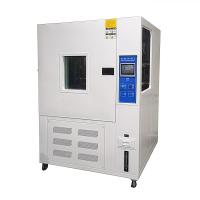
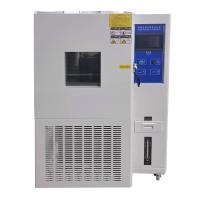
Humidity chambers are commonly used in the environmental testing industry to simulate various environmental conditions and test the durability and performance of products under these conditions. Some specific applications of Humidity Chambers in environmental testing include:
Salt fog testing: This involves exposing products to a saltwater mist in a Humidity Chamber, simulating the harsh conditions of saltwater environments. The test evaluates the corrosion resistance of materials, coatings, and products, especially those used in marine applications.
Accelerated aging testing: Humidity chambers can be used to accelerate the aging of materials and products by subjecting them to high humidity and temperature conditions. This type of testing can help predict the life expectancy of products and evaluate their durability and performance over time.
Thermal shock testing: Humidity chambers can be used in conjunction with temperature chambers to perform thermal shock testing. This involves rapidly alternating between hot and cold temperatures, which can cause materials and products to expand and contract. This type of testing is useful for evaluating the impact of temperature changes on product performance, especially for products used in extreme temperature environments.
Dust and particle testing: Humidity chambers can be used to simulate dusty and dirty environments to test the durability and performance of products under these conditions. The chambers can be used to introduce dust particles into the environment and evaluate the impact of the particles on the products.
Mold and fungal growth testing: Humidity chambers can be used to simulate high humidity conditions that promote mold and fungal growth. This type of testing can help evaluate the resistance of products to mold and fungal growth and identify materials and products that are susceptible to such growth.
Overall, Humidity Chambers are an essential tool in the environmental testing industry, helping manufacturers to evaluate the durability and performance of products under a range of environmental conditions.

Environmental testing is another important application of Humidity Chambers. These chambers are used to test the performance and reliability of various products in different environmental conditions. For example, in the environmental testing industry, Humidity Chambers can be used to simulate various humidity conditions to test the performance and durability of products such as electronic components, automotive parts, and building materials.
Humidity chambers can be used for accelerated testing, where products are exposed to elevated levels of humidity for extended periods to simulate real-world conditions. This helps manufacturers to determine how their products will perform under different humidity conditions, and identify any potential issues that need to be addressed.
Environmental testing is important in a range of industries, including aerospace, automotive, electronics, and building materials. For example, aerospace components must be able to withstand a range of environmental conditions, including high humidity and extreme temperatures. Humidity chambers can be used to simulate these conditions and ensure that the components are able to perform reliably.
In the automotive industry, Humidity Chambers can be used to test the durability of various automotive components, such as wiring harnesses and electrical connectors, under different humidity conditions. This helps manufacturers to identify any potential issues that may arise due to changes in humidity, and take steps to improve the performance and durability of these components.
In the electronics industry, Humidity Chambers can be used to test the performance of electronic components and devices under different humidity conditions. This is important for ensuring that these components are able to operate reliably in various environments, and that they do not suffer from performance issues due to changes in humidity.
In the building materials industry, Humidity Chambers can be used to test the performance of various building materials, such as insulation and roofing materials, under different humidity conditions. This helps manufacturers to identify any potential issues that may arise due to changes in humidity, and take steps to improve the performance and durability of these materials.