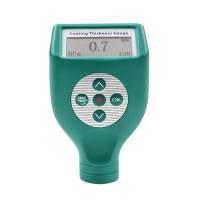
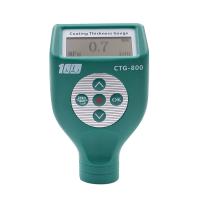
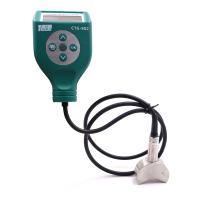
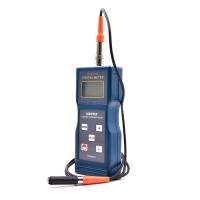
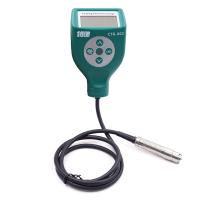
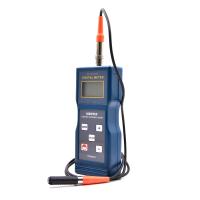
Paint Thickness Gauge is an application of Film Thickness Gauge, specially used to measure the thickness of metal surface coating or paint. It can help users to accurately measure the thickness of the coating to ensure the quality and consistency of the coating and prevent problems such as over coating or under coating.
Paint Thickness Gauges typically use non-destructive testing methods that can measure the thickness of a coating without destroying or damaging it. Its working principle is usually based on magnetic induction or electromagnetic induction technology. The probe is placed on the surface of the coated object to generate a magnetic or electromagnetic field, and then the response signal of the coating is measured to determine the coating thickness. Measurements are usually displayed in micrometers (μm) or millimeters (mm).
Paint Thickness Gauges are widely used in coatings, ships, automobiles, steel, chemicals and other fields. It can be used to detect the thickness of paint or anti-corrosion coating on metal surfaces such as car bodies, ships, buildings, etc., so as to ensure its anti-corrosion and anti-rust performance, and it can also be used to detect the coating thickness of industrial products.

common problem
Measurements are inaccurate.
Instrument readings are unstable.
The instrument is malfunctioning.
Solution
Handling of inaccurate measurement results: check the calibration and calibration of the instrument, whether recalibration or calibration is required; check the preparation of the sample surface, such as whether there are oxides or impurities; check whether the probe and measurement method of the instrument are correct, and choose the appropriate one Probe and measurement method; ensure that the temperature and humidity conditions of the instrument meet the requirements.
Handling of unstable instrument readings: Check the environmental conditions of the instrument readings, such as whether there is an interference source, whether there is a radiation source, etc., and keep it away from the interference source; check whether the instrument probe and measurement method are correct, and adjust the probe and measurement method to improve measurement accuracy Check the power supply of the instrument to ensure that the power supply is stable.
Troubleshooting of the instrument: Check whether the instrument is damaged in appearance or parts, such as whether there is a loose connector or a damaged probe; check the power supply of the instrument to see if there is a power problem; For repairs, contact professionals in time.
Precautions
In addition to the above handling methods, the following points should also be noted:
Before using the paint Thickness Gauge, you should read the operation manual carefully to understand the use method and precautions of the instrument.
During the measurement, it should be ensured that the preparation of the sample surface meets the requirements to avoid affecting the measurement accuracy.
Calibrate and calibrate the paint Thickness Gauge on a regular basis to ensure the accuracy of the measurement results.
Keep the instrument clean and maintained, and avoid dust or dirt from affecting the instrument.
Pay attention to safety when using the paint Thickness Gauge to ensure the personal safety of the operator.
In short, the paint Thickness Gauge is a commonly used testing instrument, and it needs to be maintained and calibrated during use to avoid failure and inaccurate measurement results. At the same time, it should be used according to the operation manual and precautions of the instrument to ensure safe and reliable operation.