The main purpose of UV aging test for electronic components is to evaluate their weather resistance, reliability and performance stability to determine their service life and performance in outdoor or exposed environments. UV aging tests can simulate the effects of ultraviolet radiation in sunlight and other environmental factors on electronic components.
Assess Weatherability: Electronic components are often exposed to outdoor environments and are affected by factors such as ultraviolet light, temperature changes, humidity, and atmospheric chemicals. UV aging tests can simulate these factors to evaluate the weather resistance of electronic components under actual use conditions.
Evaluating Reliability: The reliability of an electronic component is its ability to maintain expected performance under specified environmental conditions. Through the UV aging test, the stability and reliability of electronic components can be evaluated to understand whether they will undergo performance degradation, damage or failure during long-term use.
Evaluate performance stability: UV radiation can adversely affect the material and structure of electronic components, such as material aging, color fading, and electrical performance changes. Through the UV aging test, the performance stability of electronic components under ultraviolet radiation can be evaluated to determine that they can maintain the required performance during their service life.
Guide product improvement and development: Through the results of UV aging test, we can understand the performance changes of electronic components under ultraviolet radiation, so as to guide product improvement and development, and improve their weather resistance and reliability.
UV aging tests can provide important information about the weatherability, reliability and performance stability of electronic components in exposed environments. This helps manufacturers design and produce more durable and reliable electronic products, and ensures that they can work safely and reliably in a variety of environmental conditions.
Industry Standard
The UV aging test of electronic components usually needs to refer to the following industry standards:
IEC 60068-2-5: International Electrotechnical Commission (IEC) Standard for Thermal and Humid Heat Resistance Tests for Electronic Equipment. Part No. 5 of these involves UV radiation tests under solar radiation.
ASTM G154: American Society for Testing and Materials (ASTM) Standard for Ultraviolet Radiation Testing of Nonmetallic Materials. It is suitable for evaluating the weather resistance and performance stability of materials.
JIS C 60068-2-5: Japanese Industrial Standard for heat resistance and damp heat resistance tests of electronic equipment. Parts 2-5 of these involve UV radiation tests under solar radiation.
MIL-STD-810: U.S. military standard that deals with test methods and requirements for electronic equipment under various environmental conditions, including testing for ultraviolet radiation.
GB/T 2423.24: Chinese national standard for environmental test methods for electrical and electronic products. Part 24 of which involves ultraviolet radiation testing.
These standards provide guidance and specifications for UV aging tests, including requirements for test equipment, test methods, test conditions and duration. Depending on the specific application and requirements, reference may also be made to other specific industry standards or internal company specifications.
Applications
The following are some specific application cases of UV aging test for electronic components:
LED components: conduct UV aging tests on LEDs (light-emitting diodes) and their related components to evaluate their stability, brightness attenuation, and color change in outdoor environments.
Solar cell modules: UV aging tests are carried out on solar cell modules to evaluate their performance stability and weather resistance under long-term exposure to solar radiation.
Plastic Packaged Components: UV aging tests are performed on plastic packaged components used in electronic equipment to evaluate their weather resistance, color stability and mechanical strength under UV radiation.
Printed circuit board (PCB): UV aging test is carried out on PCB and its circuit components to evaluate its weather resistance, electrical performance stability and contact corrosion in outdoor or exposed environments.
Cables and connectors: Conduct UV aging tests on cables and connectors to evaluate their weather resistance, electrical performance stability and connection reliability in outdoor environments.
These application cases are only part of the ultraviolet aging test of electronic components, and the actual application can be customized and expanded according to different electronic equipment and specific needs. UV aging test helps to evaluate the weather resistance and reliability of electronic components in exposed environments, provides important performance information, guides product improvement and development, and ensures that electronic equipment can work safely and reliably under various environmental conditions.
operation method
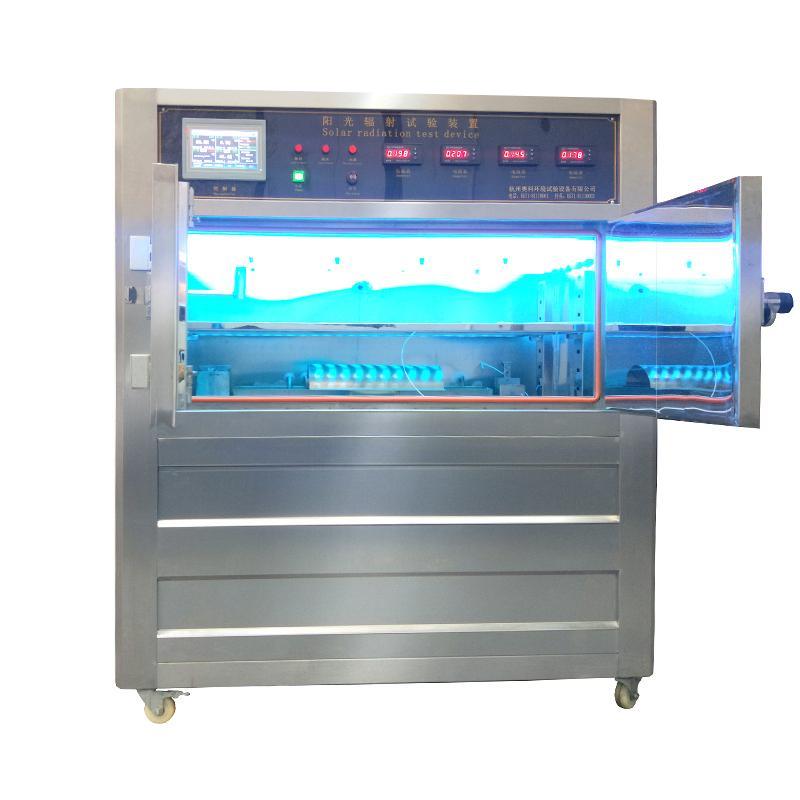
The following are the steps and precautions for testing the aging resistance of electronic components in general using a UV aging Test Chamber:
Sample preparation: According to standards or requirements, select electronic component samples of appropriate size for testing. Ensure that samples comply with relevant specifications and requirements.
Test condition setting: According to the required test conditions and standard requirements, set the parameters of the UV aging Test Chamber, including radiation intensity, temperature, humidity, etc. Pay attention to the correct setting according to the standard or requirement.
Sample placement: Place the electronic component samples on the sample holder in the Test Chamber to ensure that the samples are in a proper position and avoid mutual interference between samples.
Test run: Start the UV aging Test Chamber, and expose the samples to UV radiation under the set conditions. According to the standard requirements, set the appropriate test time, usually hundreds to thousands of hours.
Regular observation: regular observation of changes in samples, including appearance, color, size, electrical properties, etc. Document any visible changes or damage.
End of Test and Evaluation: After the test is completed, samples are removed for evaluation and testing. The physical and electrical properties of electronic components can be tested to determine their aging resistance.
When carrying out UV aging test, the following matters need to be paid attention to:
Make sure that the UV aging Test Chamber equipment is working properly, and operate in accordance with the operation manual and safety requirements.
Check and record the temperature, humidity, radiation intensity and other parameters of the Test Chamber to ensure its stability and accuracy.
Ensure that the selection, preparation and placement of samples comply with standards and requirements.
Regularly inspect and maintain Test Chamber equipment to ensure proper operation and accuracy.
Pay attention to observe and record any changes in the sample during the test for subsequent evaluation and analysis.
Please note that the exact test method and operation steps may vary according to the standard and specific test requirements, so you should carefully read the relevant standard and follow the correct test procedure before conducting the UV aging test.
