Standard Explanation
This standard applies to the determination of paint fineness. Using a scraper Fineness Meter, it is expressed in microns.
1. General provisions
![Coating Fineness Determination Method [GB1724-79] with Figure 1](http://img.nbchao.com/system/upload/day_140828/201408281025228510.gif)
Instruments and equipment:
small paint knife;
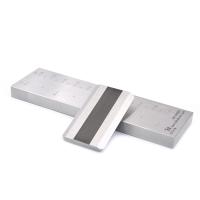
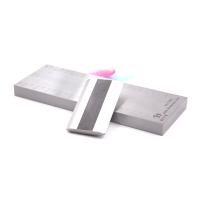
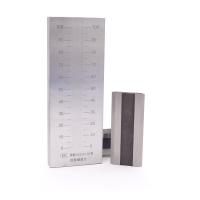
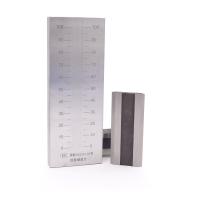
scraper Fineness Meter:
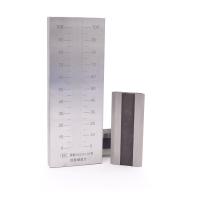
(1) The polished flat plate of the scraper Fineness Meter is made of tool alloy steel (grade Cr12), and there is a long groove on the plate (155±0.5mm long, Width 12±0.2 mm) engraved with 0~150 microns (minimum graduation 5 microns, groove slope 1:1000), 0~100 microns (minimum graduation 5 microns, groove slope 1:1000) within 150 mm length 1500), 0~50 microns (minimum graduation 2.5 microns, groove inclination 1:3000), equal division scale lines representing the groove depth. The allowable difference between the flatness of the front groove bottom and the back of the scraper Fineness Meter is 0.003mm/full length, the front surface finish should be △10, and the division value error is ±0.001mm.
(2) The scraper is made of high-quality tool carbon steel (grade T10A), both edges are polished, the length is 60±0.5mm, the width is 42±0.5mm, the allowable difference of blade straightness is 0.002mm/full length, and the surface finish is smooth is △8, and the blade grinding finish is △10.
2. Determination method
When the fineness is 30 microns or less, use a scraper Fineness Meter with a range of 50 microns; when the fineness is 31 to 70 microns, use a scraper Fineness Meter with a range of 100 microns; Plate Fineness Meter.
The scraper fineness gauge needs to be carefully cleaned and dried with solvent before use, and a soft cloth should be used when scrubbing.
Use a small paint knife to fully stir the sample that meets the standard viscosity index of the product, and then drop a few drops of the sample into the deepest part of the groove of the scraper Fineness Meter, so as to fill the groove and make it slightly redundant.
Hold the scraper (as shown in the picture) with both hands, and place it horizontally on the upper end of the polished plate (at the edge of the sample), so that the scraper is in vertical contact with the surface of the polished plate. Within 3 seconds, pull the scraper from the deep part of the groove to the shallow part, so that the paint sample fills the groove without leaving any residual paint on the plate. Immediately (not more than 5 seconds) after the scraper is pulled, make the line of sight and the groove plane form an angle of 15~30°, observe the uniformly exposed part of the particles in the groove with the light, and record the reading (accurate to the minimum graduation value). If individual particles are exposed on other graduation lines, there shall not be more than three particles within the range between the reading and the adjacent graduation line [see attached drawings (1), (2), (3)].
![Paint fineness determination method [GB1724-79] with Figure 2](http://img.nbchao.com/system/upload/day_140828/201408281025106147.gif)
3. Results and accuracy
The parallel test was performed three times, and the arithmetic mean of the two similar readings was taken as the test result.
The error of the two readings should not be greater than the minimum division value of the instrument.
Note: From the date of implementation of this standard, the original standard HG2-501-77 becomes invalid.