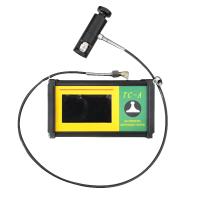
Orlov designed an instrument for measuring the adhesion of the paint film to the bottom surface, which has the same construction principle as the Diria towel Adhesion Tester. The advantage of the Orlov adhesIon Meter is that the shedding process of the paint film is carried out at a certain tearing angle (90°) by means of a motor with a fixed strength and speed. In the Erlov adhesIon Meter, the magnitude of the simple pulling force of the paint film tearing off from the bottom surface can be recorded during the whole process, and the work consumed when the paint film falls can also be measured.
According to Shu Chuanna's data, the Orlov adhesIon Meter can get better results than other types of adhesIon Meters (Die Li and towel, etc.). However, it should also be pointed out that when the adhesion of the tested paint film to the substrate is greater than the cohesive force, this instrument (like all other adhesIon Meters designed according to this phase-drop principle) is not suitable for direct measurement of paint adhesion. Adhesion of the film to the substrate. All these instruments are capable of measuring the adhesion of films made of cellulose esters and various polymeric resins (vinyl chloride, polyvinyl chloride, chlorinated rubber, etc.); For paint films such as paints with high adhesion, the test can only be carried out with the aid of auxiliary materials, usually such as textiles.
A sketch of the Orlov adhesion Tester is shown in Figure 106. This adhesIon Meter (new structure) is made of wooden frame 1, and the phonograph motor 2 that is used for carrying out the whole paint film tearing process is arranged in the lower part of wooden frame. Two parallel rods 4 are fixed from the bottom of the cover 3 of the seat frame, and four small slide blocks 5 are used on the rods 4 to move the metal platform 6 . The movable table is joined with the main shaft 8 by the guide nut 7 with twist, and the main shaft 8 connected with the main worm wheel 9 is connected with the motor by the worm screw. The electric motor that rotates the main shaft, by means of guiding the frame, gives a uniform forward movement of the mobile table on which the carriage 10 is mounted. Box 11 is embedded in the bamboo shoot of carriage, and this box can move up and down freely by four ropes 12 that are tied up and down in box. On the cover of the adhesIon Meter, a dynamometer 13 and a drum 14 with an automatic recording pen that can automatically record the tensile stress are connected side by side with the movable platform well.

The shaft of the drum is doubled by the worm gear and is connected with the main shaft of the adhesIon Meter. At the same time, the straight and slow speed of the drum rotation, the movement of the table, and the movement of the box are all consistent, so that the length of the film under test can be determined by the automatic recording pen. Record its original value on paper, so there is no need to use other scales. The dynamometer device has a load dial and a pointer.
The measured paint film is connected with the dynamometer by the help of clip 15. The movement and operation of the equipment are controlled with two traffic and green signal lamps 16, and the signal lamps are installed on the dynamometer seat and connected to the circuit through the bell transformer.
Use the following method to measure the adhesion of the paint film on the adhesIon Meter. Apply the varnish or paint to be tested to the material test panel specified in the test conditions. When dry, cut the paint film into 10 mm wide strips, and then use a blade to separate the upper end of the paint film from the bottom surface.
After that, put the test board in the box, and the box should be at the initial position, that is, at the lowest position. This process can be confirmed by the green signal light. Connect the detached end of the paint film to the dynamometer with a central plug, and then start the motor. The movable table begins to move slowly in the opposite direction to the clamp, and the box also moves upward slowly. In this way, an angle equal to 90° is maintained throughout the period of exchange.
When the box reaches the highest position, the red signal light comes on and the adhesIon Meter turns off automatically. In order to save time, the movable table and the box can be placed in the original position with a special handle (without an electric motor) that can be sleeved on the main shaft.
The average new tension can be calculated from the slow map obtained from the measurement results. Usually no less than two parallel measurements should be carried out in order to obtain the average adhesion value. The difference between parallel experiments, according to the author's data, should not be greater than 1.6%. The maximum stress measured by the dynamometer was 300 grams.
As mentioned above, for a paint film that is not very solid, that is, a paint film that is not very cohesive but has good adhesion, it is necessary to use a thin silk product to add to the paint film when measuring.
Thin cellophane can also be used instead of spun. Initial paint films made from cellulose esters, such as cellulose acetate, or from various polymeric .
Due to the different paint materials used, the time to measure the adhesion of the paint film after drying is also different (related instruments: drying time point Tester). For example, the test film of nitro paint can be carried out after one day and night, while the test film of alkyd paint can not be earlier than 10 days and night, and the film of oil-based paint can not be tested earlier than 20 days and nights. If artificial drying is used, the test time can be significantly shortened.
The main disadvantage of the Orlov adhesion Tester is that the clips connecting the paint film to the dynamometer are not properly placed, so the paint film is often torn off.
A slightly modified Orlov adhesIon Meter can be used in the leather industry to determine the adhesion of leather paint.