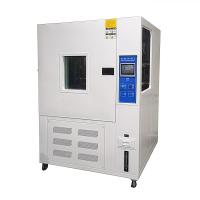
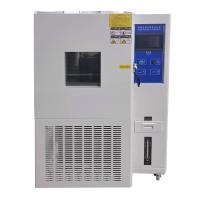
The constant temperature and humidity Test Chamber usually consists of three main systems: refrigeration system, heating system and humidification system.
Refrigeration system: The refrigeration system is mainly composed of a compressor, an evaporator, a condenser and an expansion valve. The working principle is to use the compressor to compress the refrigerant into a high temperature and high pressure gas, then use the evaporator to heat it out and cool it down and turn it into a low temperature and low pressure steam, and then dissipate heat through the condenser to condense it into a high pressure liquid, and finally use the expansion valve to expand and reduce the pressure into a low pressure steam to complete a cycle.
Heating system: The heating system generally consists of a heater and a temperature controller. The heater can generate heat energy through current to heat the temperature of the air inside the Test Chamber to reach the set target temperature. The temperature controller can adjust the power of the heater according to the temperature signal fed back by the sensor to achieve constant temperature control.
Humidification system: The humidification system is mainly composed of a Water Tank, a humidifier, a fan and a humidity controller. The humidifier increases the humidity inside the test box by heating the water to turn it into water vapor, and blowing the water vapor evenly into the test box through the fan. The humidity controller adjusts the heating power of the humidifier through the humidity signal fed back by the sensor, thereby realizing constant humidity control.

To sum up, the three systems of refrigeration system, heating system and humidification system work together to keep the inside of the Test Chamber constant within a certain temperature and humidity range by continuously adjusting the temperature and humidity, so as to meet the high-low temperature of different materials and products. Thermal performance testing requirements.