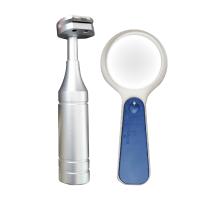
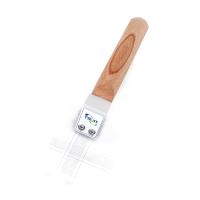
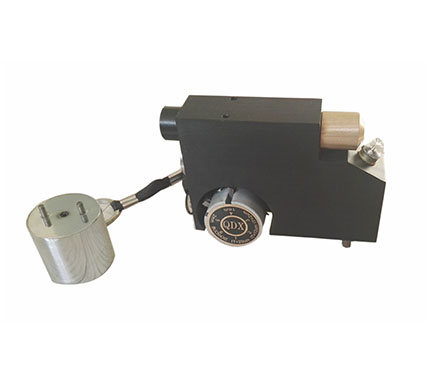
According to the method for measuring the adhesion of paint materials formulated by the Soviet Academy of Paint Science, the paint film is removed from the bottom surface using a tool acting on the wedge-shaped principle, and the resistance when the paint film is removed is measured by a dynamometer (Figure 108).
The adhesion of the paint film is represented by the resistance P, which is the force required to separate the paint film from the bottom surface on the knife along the direction of movement of the knife. Obviously, there should be a certain relationship P=f(Tα,) between the resistance P and the adhesion T, where α is the inclination angle of the knife.
The greater the value of α, the greater the resistance P to remove the paint film.
In a detailed study of the actual conditions of the paint removal process and the forces involved, it can be found in
Introducing a correction number for the frictional force between the wedge and the bottom surface, one can be used to calculate
The formula for the value of adhesion:

According to this principle, an instrument (Fig. 109) was designed in the Soviet Academy of Paint Science (HNNNJIK). Rotating wheel 2) and detachable division knife 3 (can be used to take off film from the bottom surface) and other parts constitute. The test plate 5 with the paint film is fixed on the platform by clips 4, and the platform can move freely on the track on the base plate 6 and be tied to the dynamometer by the rope 7. When some force acts (via the rope) around the wheel, the red rod 8 with the load 9 is derived from a resting state, and the angle of inclination 1 degree depends on the magnitude of the force, which force The numerical value of can be read on scale meter 10.
The scale meter is divided into 100 divisions, each division represents 20 grams. When the red rod of the dynamometer is tilted at 90°, the maximum load capacity is 2000 grams. Knife 3 is made of a steel bar with a width of 20 mm and a thickness of 1.0 mm, and its lower end is hollow. The movable connection joint of knife pity is fixed on the knife rest 11 . The inclination angle of knife is adjusted by fastening nut 12. Tool rest moves in guide rail when screw 13 flywheel l4 rotates.

The measurement procedure of adhesion is as follows. Apply the paint sample on a clean, flat and smooth test panel (glass, hard aluminum, steel, etc.) with a size of 80x120mm and a thickness of 1.5x3.0mm; after dry operation, cut the paint film along the test panel , to cut into three strips of 20 mm wide paint film; leave a 2 mm wide space between each strip. Fix the test plate on the platform of the adhesion Tester. The end of the strip of paint film is slightly tilted with a blade, and then the blade of the adhesIon Meter is placed under the paint film. Utilize the uniform rotation of the flywheel to move the knife holder from right to left.
The knife applies pressure to the paint film, and when the pressure is increased beyond that necessary for adhesion, the paint film is cut from the bottom surface. Read the resistance (expressed in grams) of removing the paint film on the dynamometer, which has nothing to do with the speed of the knife in the future. Determination of polybasic t was carried out 2 to 3 times, and the average value of several determinations was taken.
In the case of comparative tests, the same inclination a is used. In order to determine the value of angle a, the distance between the joint of the knife and the test plate and the length of the knife must be measured. The ratio of the two values is the sine of the polygon. The possibility of changing the inclination angle of the knife in the adhesIon Meter is limited (within 25°).
In the case of comparative tests, the same inclination a is used. In order to determine the value of angle a, the distance between the joint of the knife and the test plate and the length of the knife must be measured. The ratio of the two values is the sine of the polygon. The possibility of changing the inclination angle of the knife in the adhesIon Meter is limited (within 25°). However, the HNNJIK adhesion Tester is only suitable for testing coatings with low adhesion, for example, for testing coatings made of cellulose ester.
Yakubovich, Vorogushin, Livlina and others improved the structure of the HNNJIK adhesion Tester (Figure 110), making this adhesion Tester available for measuring various coatings with greater adhesion.
In this new construction of the adhesIon Meter, the wedge-shaped device for removing the paint film is replaced by the blade of a safety knife (4mm wide). In order to fix the cutter, a special cutter head is installed to ensure that the uniformity of the kiss between the cutter and the bottom surface can be adjusted, and the inclination angle and the number of revolutions of the cutter on the bottom surface can be changed. The cutter head is attached to a long and removable plate. In order to put the knife against the test plate more closely, there is a device for placing a load on the knife head. In an adhesIon Meter, the platform is not moved by hand but by an electric motor mounted under a flywheel to move it. The transmission is carried out directly through the shaft of the motor by using a rubber coupling.
In this way, it is possible to change the cutting angle and the value of the pressure on the knife, so as to find out the appropriate conditions (angle and load) to measure the adhesion of various materials.
As demonstrated by repeated tests, for most paint films on different substrates, a load of 375 grams and a cutting angle of 60-65° are sufficient in the first few days of the test, but in the following days, With the aging of the paint film, the adhesion continues to increase, so for some paint films (oil-based resin paint film, Greifa paint film, etc.), the load needs to be increased to 550 grams and the cutting angle is increased to 70~ 75°.
In the case of such a cutting angle, the compressive strength of the paint film is greater than that at a smaller cutting angle, which results in a higher index. Therefore, when using formula (I), it is necessary to introduce a correction factor in the compressive strength of the paint film according to the different cutting angles used. With the same cutting angle and the same load, completely satisfactory relative values for the adhesion of different paint films on various surfaces can be obtained.

When it is necessary to measure the adhesion of the paint film on a relatively soft bottom surface (aluminum, copper, etc.), the load needs to be reduced, because the knife cuts into the bottom surface during movement, which can affect the accuracy of the obtained results; as confirmed by subsequent experiments , When brass or bronze is used instead of steel as the material of the knife, good results can be obtained.
As indicated by the test, the adhesion of any sample coated on a glass plate as the bottom surface can be measured on a more accurate adhesIon Meter. The stress consumed by the knife rubbing on the glass plate is equal to the normal value of 80-90 g/cm.
Before describing the indirect determination of adhesion, it is necessary to introduce the instrument recently designed by AA Swinder. The fundamental difference between this device and the HNNJIK instrument is that the wedge-shaped device (knife) used to remove the paint film from the bottom surface is fixed, while the test panel coated with the paint film moves opposite the knife. In order to determine the adhesion of the paint film, the paint material must be applied to the metal sheet.