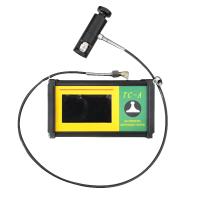
GB 1720-79 standard applies to the determination of paint film adhesion. The fastness of the paint film to the substrate, that is, the adhesion, is evaluated according to the completeness of the paint film within the scratch range of the circular rolling line, expressed in grades.
Adhesion test requirements:
Materials and equipment:
tin plate: 50X100 X0.2~0.3 mm;
four times magnifying glass;
paint brush: 25-35 mm wide;
adhesion Tester

Adhesion test general measurement method:
According to the "General Preparation Method of Paint Film" (GB 1727-79), prepare 3 samples on the tin plate (or the substrate specified in the product standard), and measure it under the conditions of constant temperature and humidity after the paint film is completely dry. Check the needle of the adhesion Tester before testing, if it is not sharp, it should be replaced:
Lift the half nut (7), pull out the test stand (6), and then the needle can be changed. When the scratches are found to be inconsistent with the standard radius of gyration, the radius of gyration should be adjusted. The method is to loosen the bolts behind the needle plate (3) and the adjusting bolt (4) for the radius of gyration, and after moving the needle plate appropriately, tighten the above If the bolts and scratches are compared with the standard circular roll line diagram, if they still do not match, the radius of gyration should be readjusted until it is the same as the standard circular roll line with a 5.25mm radius of gyration. When measuring, place the template on the test bench (6), tighten the adjusting bolts (5), (8) and adjusting bolts (10) of the fixed template, and move the lifting rod (2) backward so that the tip of the rotating needle In contact with the paint film, if the scratch does not expose the bottom plate, you should add silicon code accordingly. Shake the handle (11) evenly in a clockwise direction, and the rotation speed should be 80-100 rpm. It is 7.5 ± 0.5 cm. Move the lifting rod (2) forward to lift the pin plate, loosen the relevant bolts (5), (8) and (10) that fix the sample plate, take out the sample plate, and use a paint brush to remove the scratches. Check the scratches with a 4x magnifying glass and grade them.
How to Rating Methods for Adhesion Tests
Take the upper side of the scratches on the model as the target of inspection, and mark seven parts such as 1, 2, 3, 4, 5. 6, 7 in turn. Correspondingly divided into seven levels. Check the completeness of the paint film of each part in order. If more than 70% of the lattice of a certain part is intact, it is considered that the part is intact, otherwise it should be considered damaged. For example, if the paint film of part 1 is intact and the adhesion is very good, it is rated as the first grade; if the paint film of part 1 is damaged and the part 2 is intact, the adhesion is next, and it is rated as the second grade. And so on, grade seven is the worst adhesion.