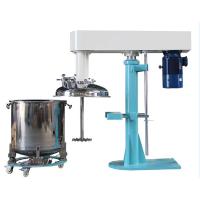
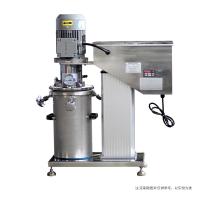
A vacuum disperser is a special equipment for effective liquid mixing, dispersing and homogenizing treatment in a vacuum environment. It is widely used in chemical, pharmaceutical, food, cosmetic and other industries to prepare high-quality suspensions, emulsions, colloidal solutions, etc. The following is an introduction to the principle, structure, characteristics and advantages, specific applications and core parameters of the vacuum disperser:

How it works
The vacuum disperser utilizes the negative pressure effect in the vacuum environment to quickly remove bubbles and gases from the liquid, thereby achieving a more efficient mixing and dispersing process. It combines high-speed stirring and vacuum extraction technology to generate shear and centrifugal forces through rotating or stirring devices to uniformly disperse particles, powders or solutes in the liquid into the matrix.
structure
Vacuum dispersers usually consist of the following main parts:
Dispersion Chamber: Used to hold mixtures and dispersion tools, usually with a sealed structure to maintain a vacuum environment.
Dispersion tools: such as stirring blades, rotating discs, etc., are used to provide shearing and centrifugal force to facilitate mixing and dispersing processes.
Vacuum System: Includes Vacuum Pumps and piping to create and maintain a vacuum environment.
Control system: used to adjust dispersion speed, vacuum degree and other process parameters.
Features and advantages
Effective mixing and dispersing: In a vacuum environment, bubbles and gases are quickly removed to improve mixing and dispersing effects.
Uniformity and stability: It can achieve uniform dispersion and homogenization to ensure stable product quality.
No oxidation reaction: In a vacuum environment, the oxidation reaction is reduced and the stability of sensitive ingredients is protected.
Controllability and repeatability: precise control of dispersion speed, vacuum and other process parameters provides a repeatable production process.
Improve production efficiency: Reduce production time and increase production capacity through high-speed mixing and dispersing.
Specific application
Vacuum dispersers are widely used in many fields, including:
Cosmetics and personal care products: preparation of lotions, cream cosmetics, emulsified perfumes, etc.
Pharmaceutical preparations: preparation of injections, oral suspensions, capsules, etc.
Food and beverages: prepare milk beverages, jams, condiments, etc.
Coatings and Inks: Preparation of pigment dispersion, ink homogenization, etc.
Chemical engineering: preparation of colloidal solutions, suspensions, polymer dispersions, etc.
core parameters
Dispersion speed: the speed and stirring force of the dispersion tool.
Vacuum degree: The extraction efficiency and vacuum degree control range of the vacuum system.
Dispersion capacity: The volume of the dispersion chamber determines the amount of liquid processed each time.
Control system accuracy: The precision and stability of the control system for dispersion speed, vacuum and other parameters.
How to operate
The following is the operation method of the general vacuum disperser:
Preparation:
Check the equipment: Make sure that all parts of the disperser are intact and the safety device is normal.
Prepare materials: Prepare liquid, solid particles or powders that need to be dispersed, and weigh them according to process requirements.
Prepare the container: Select the appropriate container to load the material and make sure the container is clean and dry.
Set parameters:
Turn on the main power: turn on the main power switch of the disperser.
Adjust the speed: according to the process requirements, set the appropriate dispersion tool speed.
Adjust the vacuum degree: turn on the Vacuum Pump and set the appropriate vacuum degree according to the process requirements.
Start dispersing:
Pour the pre-weighed material into the dispersion chamber.
Close the dispersion chamber sealing device to ensure good sealing performance.
Start the disperser: Press the start button to start the disperser tool to rotate.
Turn on vacuum extraction: According to the equipment requirements, start the Vacuum Pump and start pumping.
Observe the dispersion process: pay attention to the liquid state and particle dispersion in the dispersion chamber.
Dispersion complete:
According to the process requirements, set the dispersion time or observe the dispersion effect.
After the dispersion is complete, stop the rotation of the dispersion tool.
Turn off vacuum extraction: turn off the Vacuum Pump and stop pumping.
Open the dispersion chamber sealing device, open the dispersion chamber, and take out the dispersed liquid.
Cleaning and Maintenance:
Turn off the main power of the disperser.
Clean the dispersion chamber and dispersion tools to ensure no residue.
Inspect and maintain various parts of the equipment to ensure its normal operation.
Regularly change lubricating oil and maintain hydraulic system (if any) according to equipment requirements.
Please note that the above operation methods are general instructions, and the specific operation steps may vary according to different vacuum disperser models and manufacturers. Therefore, before operating the equipment, be sure to carefully read and follow the operation manual and safety guidelines provided by the manufacturer to ensure proper operation and safe use of the equipment.