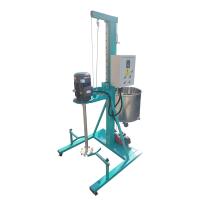
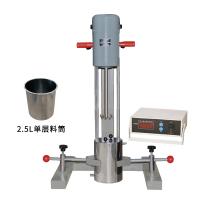
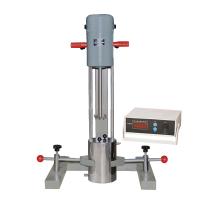
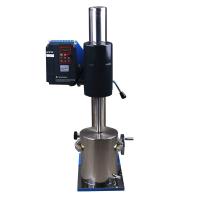
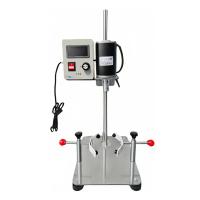
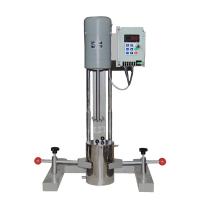
The single-axis and double-axis of the high-speed disperser refer to the difference in the axial number and structure of the dispersing tool.

Single shaft high-speed disperser:
The single-axis high-speed disperser has only one axial direction of the dispersing tool.
The dispersing tool is usually a rotating disc or blade fixed on the shaft of the disperser.
Single-axis high-speed dispersers are suitable for dispersing operations that require smaller scales, such as laboratory or small batch production.
The dispersion tool rotates on a single axis, producing high-speed shear and strong turbulent effects, resulting in dispersion and homogenization of the liquid.
Double shaft high-speed disperser:
A dual-axis high-speed disperser has the axial direction of two dispersing tools, usually V-shaped or arranged in parallel.
The dispersion tool can be a disc, a blade or other shaped structure, which can be selected according to different process requirements.
The dual-shaft high-speed disperser has greater dispersing capacity and processing capacity, and is suitable for large-scale production and processes that require higher dispersing effects.
The interaction of the two dispersion tools can increase shear and turbulence effects, dispersing liquids and homogenizing materials more efficiently.
In general, single-axis high-speed dispersers are suitable for small-scale and simpler dispersion processes, while dual-axis high-speed dispersers are suitable for large-scale and complex dispersion processes. Which type of disperser to choose should be determined according to the specific process requirements, production scale and expected dispersion effect.