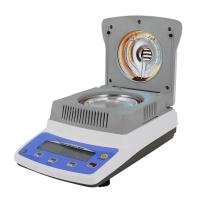
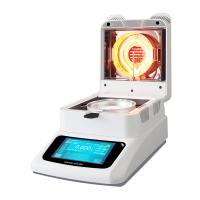
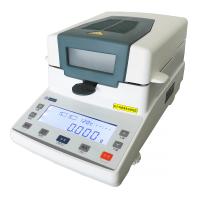
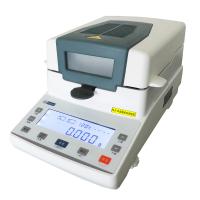
Halogen Moisture Analyzer and Thermogravimetric Analyzer are two common instruments used to determine the moisture content of substances. Their main differences are as follows:
Halogen Moisture Meter:
Principle: A halogen Moisture Meter uses halogen as a heating source to evaporate the water in the sample and detach it from the sample. Calculate the moisture content in the sample by measuring the weight the sample loses during heating.
Easy to operate: Halogen Moisture Meters usually have a simple interface and automation function, making moisture determination fast and convenient.
Scope of application: Halogen Moisture Meters are suitable for measuring moisture content in solid, liquid and paste samples.
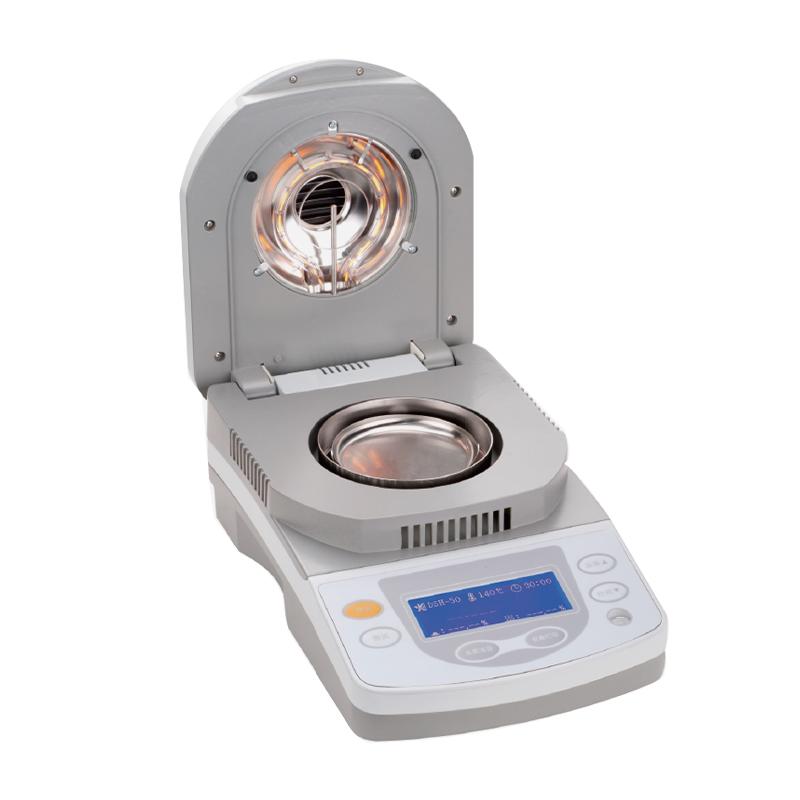
Thermogravimetric meter:
Principle: The thermogravimetric meter measures the change of sample quality with temperature by heating the sample at a controlled heating rate. The moisture in the sample evaporates during the heating process, resulting in a decrease in sample quality. By analyzing the change of sample quality with temperature, the moisture content in the sample can be determined.
Versatility: Thermogravimetric meters generally have a wider range of applications and can be used to measure parameters other than moisture content, such as volatile substances, combustion residues, etc.
More complex operation: The operation of the thermogravimetric meter is relatively complicated, usually requiring longer test time and more operation steps.
In general, halogen Moisture Meters are suitable for fast and accurate determination of moisture content in samples, especially for daily quality control and rapid analysis. Thermogravimetry, on the other hand, has a wider range of applications and can provide more analytical parameters. Which instrument to choose depends on actual needs, sample properties and experimental requirements.