Measuring the surface tension of an ink is very important because the surface tension of an ink directly affects its wettability and propagation during printing and coating. Understanding the surface tension of an ink can help us evaluate its adhesion and propagation properties on different substrate surfaces to ensure that the ink can evenly and stably cover and adhere to the target surface during printing.
By measuring the surface tension of the ink, we can understand its wettability, propagation and print quality in order to adjust and control the performance and application of the ink. This helps to improve the quality, consistency and reliability of the printed matter. Please note that specific test methods and instruments may vary depending on different ink types and application requirements. Therefore, before conducting tests, it is recommended to refer to relevant standards and specifications and consult professional laboratories or testing agencies for more specific and accurate recommendations.
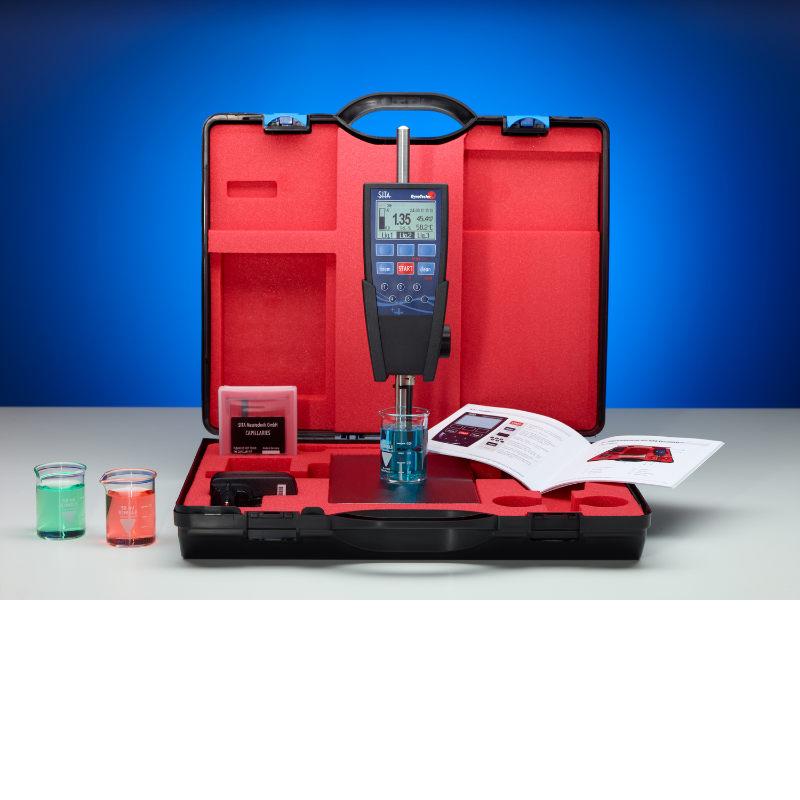
Test method
Dripping method: Drop a drop of water on the surface that has been coated with ink. Observe the behavior of the water droplets on the surface of the ink, including whether the water droplets expand rapidly, spread or aggregate into beads, etc. If the water droplets expand rapidly and distribute evenly on the surface of the ink, it indicates that the surface tension of the ink is low. If the water droplets gather into beads on the surface of the ink or cannot be evenly distributed, it indicates that the surface tension of the ink is high.
Static balance method: Use a balance dynamometer or Surface Tensiometer to determine the surface tension by measuring the balance between the surface tension of the liquid and the force in the vertical direction. To measure the surface tension of the liquid on the ink surface, the immersion method of the dynamometer or the peeling method can be used.
Contact Angle Measurement Method: Use a contact angle measuring instrument (such as a contact angle meter) to measure the contact angle formed when ink comes into contact with other liquids (such as water). Depending on the size and shape of the contact angle, the surface tension of the ink can be indirectly evaluated. A smaller contact angle indicates a lower surface tension, while a larger contact angle indicates a higher surface tension.
These methods can help assess the surface tension of the ink. It should be noted that the surface tension may be affected by factors such as temperature, humidity and ink composition. Therefore, when conducting the test, the environmental conditions should be controlled and recorded as much as possible, and the operation should be carried out with reference to standardized methods. If a more accurate and professional assessment is required, it is recommended to consult a professional laboratory or testing agency, who can provide more detailed tests and analysis.
