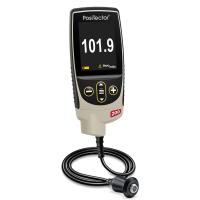
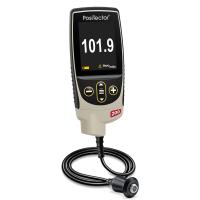
The NBCLab instrument has come to evaluate the test again. The Defelsko PosiTector200C ultrasonic coating Thickness Gauge is specially used to test the thickness of the coating layer on concrete and glass fiber. In this issue, share how the NBCLab technical engineer uses the PosiTector200C ultrasonic coating Thickness Gauge to measure the thickness of concrete coatings. What is the effect of the thickness measurement data?

First of all, let's understand the application significance of coating thickness testing on concrete. Coating on concrete usually refers to a layer of material coated on the surface of concrete, such as paint, waterproof layer, anti-slip layer, etc. These coatings play a role in protecting, beautifying, waterproofing, anti-corrosion, etc. in concrete structures. Ensuring that the thickness of the coating meets design requirements and construction standards is critical to safeguarding the performance and service life of concrete structures.
The general application scenarios are as follows:
Building construction and maintenance: After the construction of a new concrete structure is completed, the thickness of the coating needs to be measured to ensure the waterproof, anti-corrosion and aesthetic functions of the coating. When maintaining and repairing existing concrete structures, measuring the thickness of the coating can also help determine whether the coating needs to be reconstructed or repaired.
Road and Bridge Engineering: In the construction of roads, bridges and other transportation infrastructure, anti-skid or wear-resistant coatings are commonly used to improve the durability and safety of road surfaces. Measuring the thickness of these coatings is critical to ensuring the quality and service life of roads and bridges.
Architectural decoration: In interior decoration, paints or wall coatings are often used to decorate and protect concrete walls. Measuring the thickness of the coating helps ensure the decoration effect and decoration quality.
Reinforced concrete structures: In reinforced concrete structures, carbonization-resistant or fire-resistant coatings are commonly used to protect steel and concrete. Measuring the thickness of these coatings helps ensure the durability and safety of the structure.
So how important is a suitable coating thickness, not only to play a sufficient protective role, but also to save costs as much as possible and reduce unnecessary waste, so the thickness test of concrete and floor coatings is a necessary link.
Of course, there are many methods for testing the thickness of coatings on concrete, including mechanical method, non-contact method, and ultrasonic method. Among them, the simpler and faster one is non-destructive ultrasonic thickness measurement. Defelsko200 series ultrasonic coating Thickness Gauges are also found in CHINA at present. A relatively cost-effective one, let's see how the technology is tested.
It should be understood here that the positector 200C ultrasonic Thickness Gauge has a range of 50 to 3800 microns and a thickness measurement accuracy of ± 3%. In the video, the thickness of the concrete sample sent by the customer is in the range of 1300 to 1800 μm. Because the concrete is relatively rough, the technical engineer uses multi-point tests to take the approximate average value, and single-point and multiple tests to ensure the accuracy of the thickness measurement. Overall, the data is relatively stable, and the measured data is ultimately satisfactory to the customer.