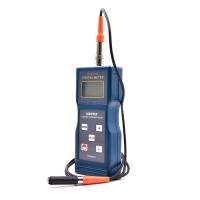
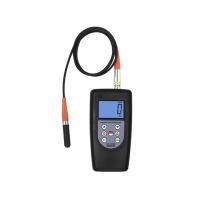
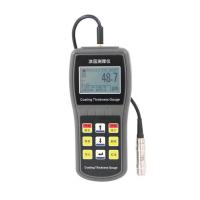
Plastic coating thickness is measured because the coating thickness directly affects the performance, appearance and service life of the coating. Whether in industrial production or experimental research, it is important to know the coating thickness. Coatings are often used to provide protection of plastic surfaces against chemical corrosion, wear, oxidation, etc. The correct coating thickness ensures the long-term durability of the material in the environment. Controlling the coating thickness can effectively manage the use of coatings and materials, reduce waste and reduce costs. The thickness of the coating is closely related to mechanical properties. For example, in some applications, excessive coating thickness may lead to changes in elastic modulus, which can affect the strength and stiffness of plastic products.
![Curved plastic coating thickness test application scheme [with test video] Figure 1](http://img.nbchao.com/upload/editor/image/20230810/1691630302587079698.png)
Plastic is a non-metallic substrate, and general coating Thickness Gauges cannot be used to test its coating thickness. There are two test methods: 1. Mechanical damage thickness measurement; 2. Non-destructive ultrasonic thickness measurement. From the perspective of measurement accuracy, cost loss and efficiency, non-destructive ultrasonic coating thickness measurement is undeniably more convenient and efficient, which will not damage the coating and can intuitively read accurate data.
In this issue, for the thickness test of curved plastic coatings, North-South Technology recommends the following instrument solutions.
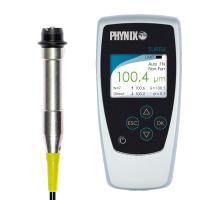
| Defelsko PosiTector 200 B1 Ultrasonic Coating Thickness Gauge |
| Specifications: Measurement principle Ultrasonic, measurement range 13~ 1000μm, error range ± 3%, application of wood, plastic and other polymers coated, calibration certificate can be traced back to NIST or PTB (long table), unit display μm/mils, statistical function Maximum value, minimum value, average value, standard deviation, no graphic function, data interface USB, data storage 250 readings, power supply alkaline battery or rechargeable battery, meet standard ASTM D6132, ISO 2808, system language Chinese, English and other 16 languages are optional |
![Curved plastic coating thickness test application scheme [with test video] Figure 2](http://img.nbchao.com/upload/editor/image/20230810/1691630080589099991.jpg)
In order to verify the feasibility of this scheme, NBCHAO Technical Engineering conducted an experimental test, took two curved plastic samples for coating thickness measurement, and adopted a multi-point test method. See the test experiment video below for details。
Below are some footage of the video. It should be noted that the size of the sample in the experiment is relatively large, and the measured surface is larger than the contact surface of the test probe. If it is smaller than the contact surface of the probe, it will affect the accuracy of the test.
![Curved plastic coating thickness test application scheme [with test video] Figure 3](http://img.nbchao.com/upload/editor/image/20230810/1691630325258065864.png)
![Curved plastic coating thickness test application scheme [with test video] Figure 4](http://img.nbchao.com/upload/editor/image/20230810/1691630339976026099.png)
![Curved plastic coating thickness test application scheme [with test video] Figure 5](http://img.nbchao.com/upload/editor/image/20230810/1691630395072011594.png)