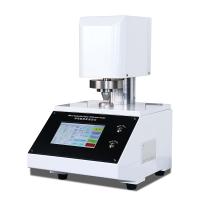
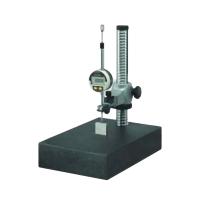
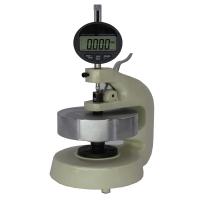
In paper and board production and related fields, the thickness of paper is an important parameter that directly affects the quality and performance of the product. In order to accurately measure the thickness of paper and board, an electric thickness meter is a commonly used test instrument, also known as a thickness meter, micrometer or micrometer.
Structure and working principle
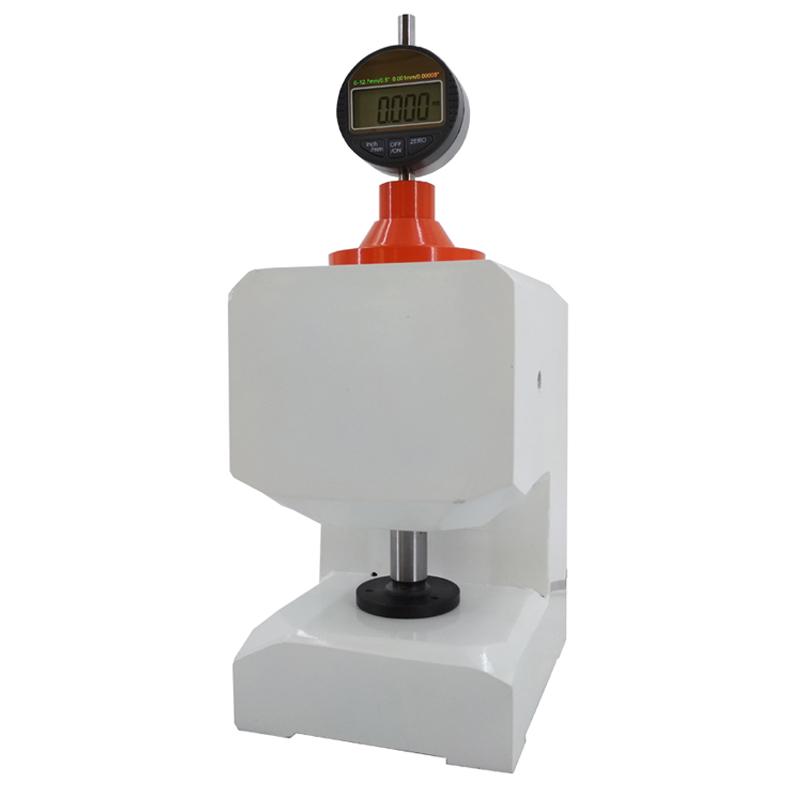
The electric Thickness Gauge mainly consists of a standard measuring head and a frame capable of performing measuring actions. The frame is equipped with components such as a motor, cam and lever. The operation of the motor drives the cam, and the movement of the cam causes the heavy thallium to generate a contact pressure for measuring the thickness. The measurement result is displayed on the watch head.
Technical parameters
The main technical parameters of the electric Thickness Gauge include measurement range, measurement accuracy, contact pressure, contact area and lifting speed. Its measurement range is usually 0~ 3mm, and the measurement accuracy is determined by the accuracy of the meter head. The contact pressure is (1 ± 0.1) kgf/cm ², the contact area is (2 ± 0.05) cm ², the lifting speed is 8 times/min, the rising speed is 2mm/s, and the falling speed is 1mm/s.
Calibration procedure
Before measuring with an electric Thickness Gauge, calibration is required. First, start the motor to lower the measuring head to the lowest position, observe the dial and rotate the dial to the zero position of the dial. Then, press the button to repeatedly lift and lower the measuring head several times until the pointer stabilizes at the zero position indication.
Test method
According to the provisions of the national standard GB 451.3, use an electric thickness meter to test the thickness of paper and cardboard. The test steps are as follows:
20 samples of 100mm × 100mm (or 200mm × 250mm) were cut and pretreated with temperature and humidity.
According to the requirements of the thickness range and measurement accuracy of the tested sample, select and install the micrometer, and make the pointer zero.
Start the instrument, raise the measuring head, sandwich the sample between the upper and lower measuring surfaces, lower the measuring head for measurement, and read the measurement value within 2 to 5 seconds after the pointer is stable.
Raise the measuring head, move the test sample, and make a second measurement. For single-layer samples, the measurement point should be far away from the edge, for multi-layer samples, measure at the specified point, and then take the average of all measurement data as the thickness of the paper or cardboard.
To sum up, electric thickness meters play an important role in paper and board thickness testing, and their precise measurement and easy operation help ensure that the quality and performance of the product meet the expected standards.