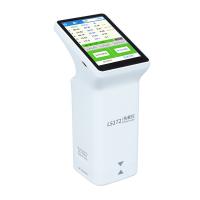
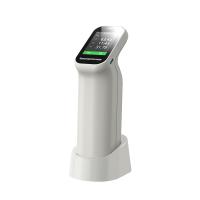
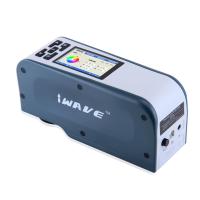
"D/8", "D/0" and "45 °/0" are terms used to describe the optical structure and measurement geometry of a Spectrophotometer , which describe how light reflected from a sample surface enters and leaves the instrument. These terms are often used to describe instruments that measure color and optical properties, such as Colorimeters and spectrometers.

D/8 (Diffuse/8 °)
"D" stands for Diffuse, which means that light is scattered from the sample surface into the Colorimeter in a uniform manner.
"8" represents the viewing angle, which is the angle at which the light is viewed. In the D/8 structure, the light is viewed at an angle of 8 degrees on the sample surface.
The D/8 structure is often used to measure surface color, such as paint, plastic, paper, etc., because it simulates the way we usually see objects with our eyes. This structure excludes most specular reflections and only considers diffuse light.
D/0 (Diffuse/0 °)
"D" stands for Diffuse, where light is scattered from the sample surface into the Colorimeter in a uniform manner.
"0" means that the viewing angle is 0 degrees, that is, the light is observed perpendicular to the surface of the sample.
The D/0 structure is commonly used to measure the color of various surfaces, including metal, glass, etc., as it measures all reflected light, including diffuse and specular reflections.
45 °/0 (45 ° ring/0 °)
"45 °" means that the light is incident on the sample surface at an angle of 45 degrees.
"0 °" means that the viewing angle is 0 degrees, that is, the light is observed perpendicular to the surface of the sample.
The 45 °/0 structure is often used to measure the color of high-gloss surfaces such as mirrors, metals, glossy paper, etc., as it takes into account reflections at specific angles, allowing the measurement of specular reflections on surfaces.
Taken together, these terms describe different optical configurations of color measuring instruments, suitable for different types of surfaces. Choosing the right measurement geometry is important for accurately measuring color and optical properties, as different sample surfaces reflect light in different ways. Therefore, it is critical to choose the right geometry as needed.