1. Introduction
As a commonly used coating material in construction and industry, the mass of paint film directly affects the Smoothness and aesthetics of the painting surface. In the process of painting, it is often necessary to sanding the film surface to achieve a smoother, matte, particle-free effect and improve the mass of painting. This article will introduce the sanding method of paint film in detail, including definitions, objectives, relevant standards, key points of inspection methods, instruments and equipment, operation points, result judgment and precautions.
2. Definition, purpose and meaning
The sanding property measurement method of paint film refers to the difficulty of producing a smooth and matte surface on the surface of the paint film by sanding the paint film or putty layer, using different materials such as pumice, sandpaper, etc., and different sanding methods such as dry grinding or wet grinding. Its purpose is to measure the Smoothness that the paint film can achieve after sanding, which is an important performance indicator for primer and putty. The sanding performance of the paint film directly affects the construction mass, and also improves the protection and adhesion of the film.
3. Relevant standards
GB/T 1770 is the relevant standard for the determination of the sanding performance of primer and putty films, which provides specifications and guidance for the determination of the sanding performance of paint films.
4. Introduction to the main points of inspection methods
4.1 Determination principle
The sanding performance of the paint film is evaluated by sanding the paint film and then observing the phenomenon on the surface of the paint film.
4.2 Equipment
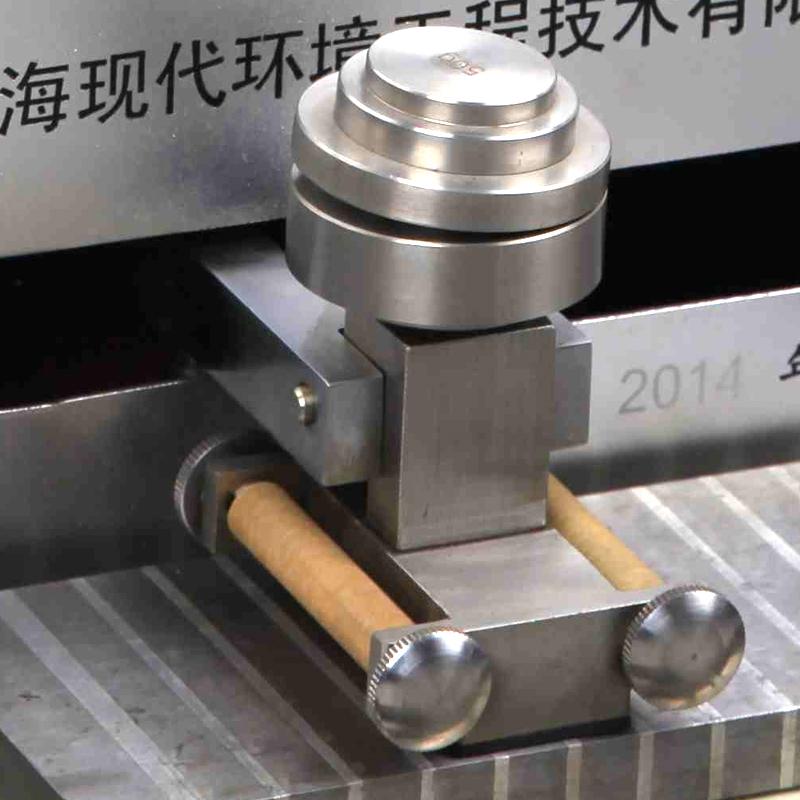
Abradability Tester, commonly used in laboratories and painting sites, can effectively simulate the sanding process in actual construction.
4.3 Operation points
Install the specified type of water sandpaper on the grinding head of the instrument, add a certain load, and then place the sample to be tested on the magnetic table. The grinding head reciprocates, and the surface phenomenon of the sample is observed after a certain number of times. When hand sanding, use water sandpaper to evenly rub the sample, you can choose dry grinding or wet grinding.
4.4 Judgment of results
The results are evaluated with two samples with similar phenomena to determine whether the surface is uniform, smooth and matte, and whether there are particles that cannot be worn off or become soft with heat.
4.5 Precautions
In manual sanding, attention should be paid to the uniformity of force and sanding speed, and the specified type of water sandpaper should be selected to ensure the accuracy of measurement.
5. Method application and significance
Smoothness and construction mass of the film can be evaluated by the sanding method. By suitable sanding method and technology, the surface of the film can be smooth and particle-free, the decorative effect and adhesion of the film can be improved, and the substrate can be protected.
6. Conclusion
The method of film sanding is an important method for evaluating film surface Smoothness. Through this method, the film sanding performance can be grasped, and reliable data and guidance can be provided for the improvement of construction mass and film performance. In painting engineering, the rational use of the film sanding method is helpful to achieve a higher level of construction mass and decorative effect.