The two main purposes of surface preparation are to roughen and clean the surface. Specifying a specific blast profile does not indicate the cleanliness of the blast, and the two need to be considered separately. Surface profile, anchor pattern, or roughness is defined as the maximum average peak-to-valley depth (or height) caused by the impact of an abrasive on the substrate. Either SSPC-SP 5 or -SP 6 can have a surface profile of 0.025 to 0.10 mm (1 to 4 mil). Surface profiling effectively increases the surface area to which the coating can adhere and provides mechanical anchoring to aid adhesion. Generally speaking, thicker coatings require a deeper surface profile than thinner coatings.
Specifying the surface profile is crucial. Surface roughness that is too shallow can cause adhesion difficulties, while surface roughness that is too deep (and insufficient coating thickness) can cause pinhole rust as unprotected contour peaks protrude above the coating surface. In general, the surface profile should be 15% to 20% of the total coating system thickness (0.38 mm [15 mils] maximum).
Surface profile measurements are typically performed on site or in the shop using three types of instruments: visual surface profile comparators, depth micrometers or replica tapes . Civil Engineering Guidelines require the use of replica tape.
Keane-Tator and Clemtex anchor pattern comparator
A visual comparator can be used to evaluate the average peak and valley depth after blast cleaning. Samples or disks representing various profile depths are compared to the existing surface to determine the surface profile. However, different types of abrasives can result in different profile appearances, even though the depth may be the same. For example, a sandblasting profile is rounded compared to the more angular abrasive profile. To achieve similar profile depths, shot peening typically results in larger lateral distances between peaks due to its shape, which will result in lower peak counts for a given area. Optical effects can cause a sandblasted surface to appear deeper than an abrasive-cleaned surface under the same conditions, even if they are the same depth. Therefore, before determining the surface profile, it is critical to select a reference disc or sample that is representative of the typical abrasive types used to clean the surface.
depth micrometer
Another field instrument used to determine average profile depth is a depth micrometer. The instrument consists of a tapered needle projecting from a large flat base about the size of a nickel. The instrument is calibrated on a mirror or glass plate by rotating the entire scale reading so that the zero line is aligned with the pointer. In theory, when the instrument is placed firmly on the polished substrate, the base will rest on the peaks and the needles will reach into the valleys. An average profile can be obtained by taking multiple readings. The instrument must be picked up and lowered for each reading rather than dragging it across the contour, otherwise the tip will become dull, resulting in false readings.
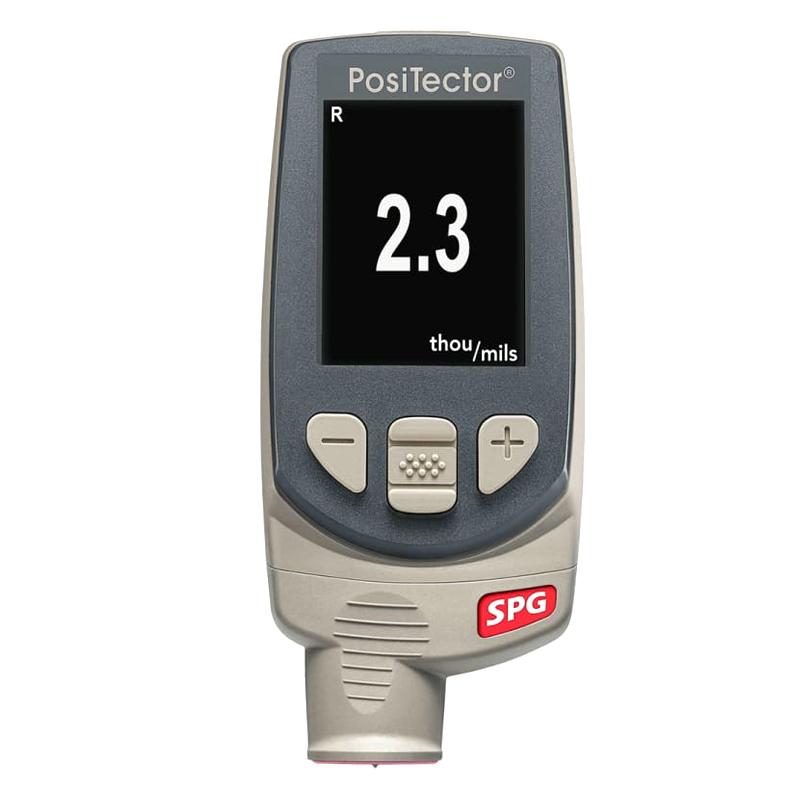
copy tape
Surface contours can be determined using copy tape. Replication tape consists of an emulsion film of tiny bubbles attached to a uniform 0.05 mm (2 mil) polyester film. The strip is pressed onto the polished surface, emulsion side down, and the polyester membrane is rubbed vigorously with a blunt object. The peaks of the profile will break up the air bubbles and eventually contact but not change the thickness of the polyester since it is incompressible. The strips are then measured using a lightweight spring-loaded micrometer that provides a reading from the upper surface of the polyester to the high points of the emulsion that are not completely flattened (corresponding to the valleys of the profile). The total micrometer reading is adjusted for the thickness of the polyester to provide a direct reading of the maximum average profile. Replication comes in multiple grades that can be used to measure different ranges of profiles, from less than 1.0 to greater than 4.0 mil. Replicated tapes will usually retain their imprints permanently if stored in a cool, stress-free area. A copy of the outline should be permanently saved for future reference. The date, time, method used, measurement location and profile measurements should be recorded.