The national standard GB/T13452.2 Determination of paint film thickness of paints and varnishes is equivalent to the international standard Is028o8. This standard comprehensively regulates various thickness measurement methods of dry film and wet film of coating films.
Coating film thickness measurement method 1
It is a method of measuring dry film thickness through the corresponding relationship between dry film mass and dry film thickness. This method is suitable for coating films that are too soft to be measured by instruments. For example, air-dried coatings in the early stages of cure. The purpose of this method is not to accurately measure the actual thickness of the coating film. This method should refer to the relationship chart between dry film quality and thickness to obtain the corresponding film thickness.
Coating film thickness measurement method 2
The dry film thickness is measured by the thousand percent card method. When using this method, the coating film needs to be hard enough to withstand close contact with the micrometer chuck without indentation, with an accuracy of ± 2 µm.
Coating film thickness measurement method 3
The dry film thickness is measured by the finger gauge method, and the finger gauge looks like a common dial gauge. .Applicable scope and accuracy are the same as method 2.
Coating film thickness measurement method 4
The dry film thickness of the paint is measured by microscopy. This method is divided into A method and B method. Method A is to cut a part from the painted sample or the object to be painted and bury it in the resin, and measure it with a microscope, with an accuracy of ±2.5µm. It is recommended as the referee method and for the measurement of film thickness on variable profile substrates such as shot peened metal. The B rule is to use a special microscope to observe and measure the thickness of a small part of the longitudinal section of the coating film removed from the substrate. The measurement accuracy is 1µm.
Coating thickness measurement method 5
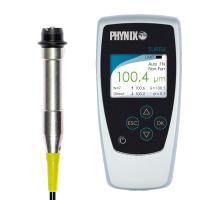
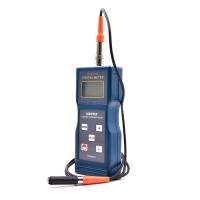
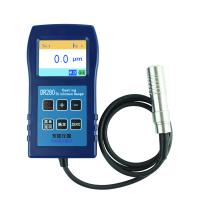
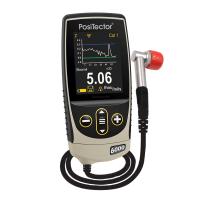
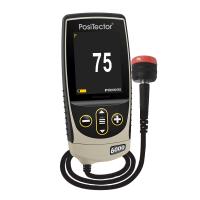
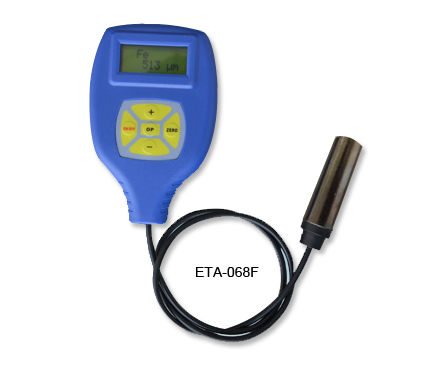
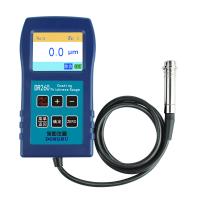
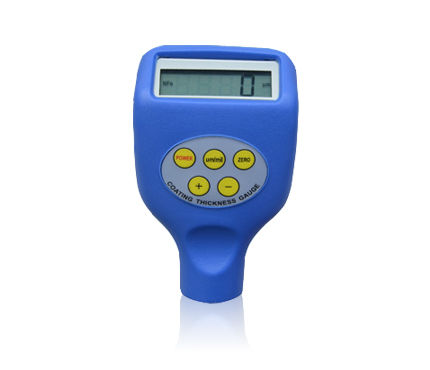
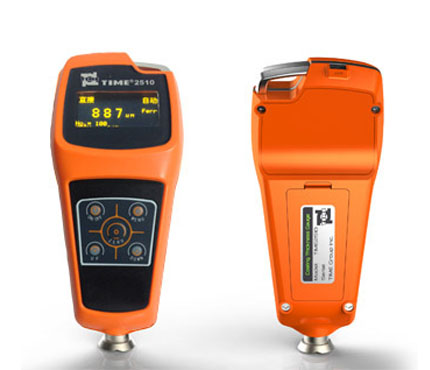
It is a non-destructive instrument measurement method, that is, a method of measuring the degree of coating without destroying the coating film. One is suitable for magnetic metal substrates. The operation of the instrument is based on the principle of magnetic flux, eddy current and magnetic attraction.
Here is a special introduction of the magnetic attraction supporting column type Thickness Gauge, which measures the thickness of the coating film with the force required to overcome the magnetic attraction of the long-term enamel paint and magnetic substrate inspection. This attractive force varies with the thickness of the magnet and substrate and is measured as the force exerted by the tension of a spring coil attached to a permanent magnet. This kind of coating Film Thickness Gauge is widely used on railways now. Its advantages are that it is easy to carry, does not need a power source, and can directly measure the coating film thickness on the coated steel structure.
There is another method suitable for measuring coating film thickness on non-magnetic metal substrates. The principle is that the size of the induced eddy current changes with the coating film thickness between the probe coil of the instrument and the metal substrate. The instrument measures the thickness of the coating film by inducing the change of eddy current. This method cannot measure coating films containing metallic pigments. It is useful for the coating of aluminum alloy car bodies used in high-speed trains.
There is also a non-destructive instrumental measurement method here: β-ray backscattering method. It is a highly specialized instrument with a radioactive source, mainly used for continuous measurement of the coating film thickness in motion, such as coil coating, but the coating film needs to be uniform.
Coating film thickness determination method method 6
It is the measurement of wet film thickness, and there are two kinds of measuring instruments: wheel gauge and comb gauge.
The wheel gauge is suitable for the wet film thickness of the laboratory model or the newly painted surface. The measurement accuracy is poor, but it can estimate the approximate position of the film after drying.
The comb gauge is suitable for the measurement of wet film thickness during on-site coating operation, and the measured value can only be slightly heavier. For a specific coating, the thickness of the dry film can be estimated by measuring the wetness