Viscosity measurement is of great significance in fields such as chemical engineering, materials science, and manufacturing. The cone and plate viscometer is a commonly used instrument used to measure the viscosity of polyester resin, powder coatings and other substances in the molten state. This article will introduce the measurement method, principle and application of cone and plate viscometer in different fields.
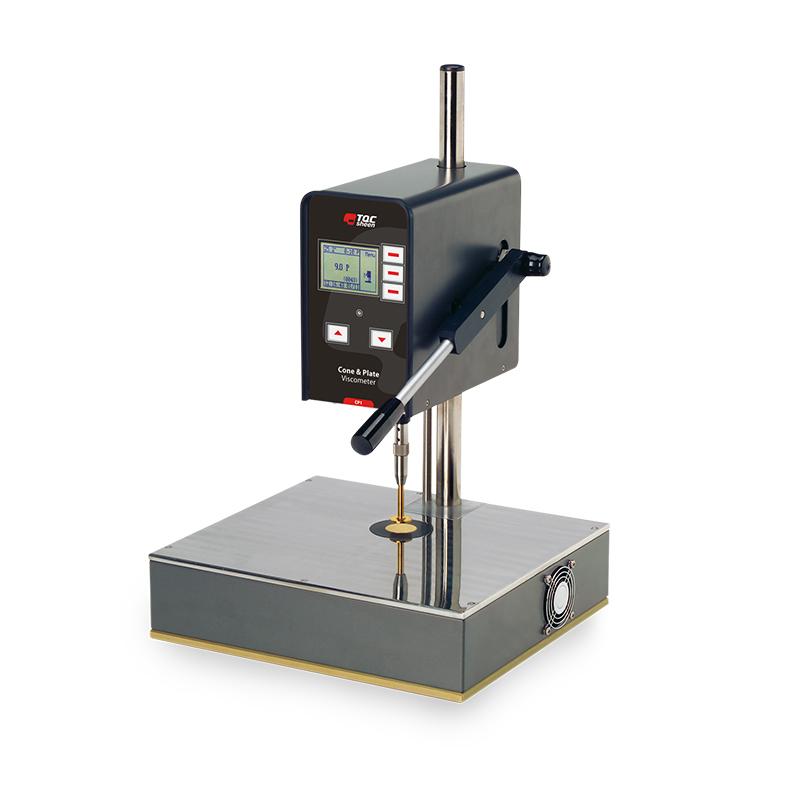
Instruments and measurement methods
The cone and plate viscometer consists of a constant temperature Heating Plate, a rotating cone, a torque motor, a torque converter and a reading display system. When measuring, first accurately weigh about 0.1 grams of sample and place it between a clean plate and a cone. Then choose a suitable temperature, such as 150°C or 175°C, and heat to a constant temperature. After the sample has melted and stabilized to the set temperature, start the rotating cone and record the reading after the viscosity indicator becomes constant. Carry out two parallel experiments for each determination, take the average and report the results.
Principle of viscosity measurement
At a constant temperature, the object to be measured is in a molten state, a static layer of fluid is formed at the bottom, and the upper layer of fluid is driven by the rotating cone. During this process, there is a velocity gradient inside the fluid, and the internal viscosity is determined by the fluid of the measured object. The ICI cone and plate viscometer measures the viscosity of a substance through this principle.
Applications and Reference Standards
The cone and plate viscometer is simple to operate, has few samples, and is easy to clean. It is suitable for medium and high value viscosity measurements and can directly read the viscosity value. The United States recommends this method for powder coating viscosity measurement and has been adopted as an ISO standard. In addition, standards such as ISO 28841-1 and DIN 53214 provide guidance on viscosity determination.
Viscosity is the internal resistance of an object to flow in a liquid state, and its measurement is critical to the production and quality control of various materials. As a commonly used and reliable measurement tool, the cone and plate viscometer plays an important role in various industries and provides an effective means to ensure material performance.
