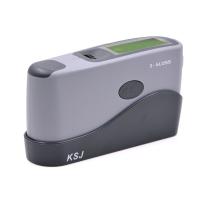
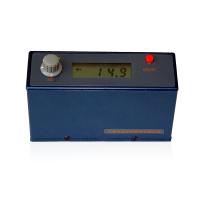
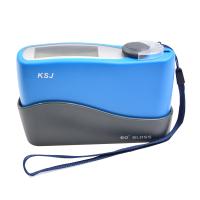
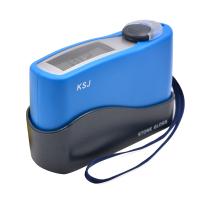
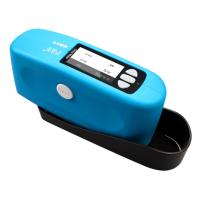
The so-called specular gloss refers to the relative reflectance of the sample in the mirror reflection direction, and the reflectance refers to the ratio of the luminous flux of the reflected light of the sample to the luminous flux of the incident light within a specified solid angle.
GB1743 stipulates that a photoelectric Glossmeter with a fixed angle is used, expressed as a percentage of the ratio of the amount of regular reflection light from the surface of the standard plate, and the incident angle of the light is 45°.
The current supply conditions of Tuke Technology have all used 60° angle gloss as the control to refer to the coating gloss of metallic pigment paint. For example, the finish paint used for railway steel bridges - the mirror gloss of steel gray zinc aluminum powder alkyd enamel paint cannot use this standard.

The following provisions are made in the gloss measurement standard of this specification:
The 60° method is suitable for the coating film of all colored paints, but the 20° and 85° methods are more suitable for the colored paints with particularly high gloss or near dull colored paints.
The 20° method can improve the identification ability of the high-gloss paint film, and is suitable for paints with a 60° gloss higher than 70 units.
The 85° method is mainly suitable for the coating film of low-gloss paints, and it is suitable for paints with a 60° gloss of less than 30 units.
When measuring the gloss of the coating film, the gloss meter standard plate is an important factor for accurately measuring the gloss. Basic panels are available as highly polished black glass panels or as clear glass panels with the back and edges frosted and painted black. In addition, a highly polished black glass plate with a refractive index η D = 1.567 is specified to have a specular gloss of 100 for each angle of incidence . Gloss values for glasses with other refractive indices can be calculated using the Fresnel equation. Roughly: for every increase or decrease of 0.001 in the refractive index, the change in gloss value at angles of 20°, 60° and 85° will be 0.27, 0.16 and 0.016 respectively. For example, for a standard plate (glass plate) with a refractive index of 1.523, the gloss at 20° is 88.1, the gloss at 60° is 93.0, and the gloss at 85° is 99.3.
The situation mentioned here is only the correction of the gloss value of the basic standard plate, and does not reflect the mutual conversion relationship of the gloss measured by the same coating film model at different incident angles.
Generally speaking, the value measured with a 60° Glossmeter is slightly larger than that measured with a 45° Glossmeter. ASTM D147 160° Specular Gloss Two Parameters This standard test method was originally intended to evaluate the two parameters specified on the 60° specular gloss surface of non-metallic samples, but this standard has ceased to be implemented in 1976, and there is no revised version.