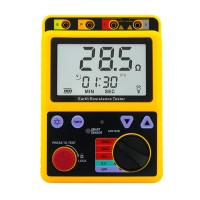
Material resistivity is an important physical quantity that describes the conductive properties of materials. Its size is affected by factors such as material type, composition, temperature, and pressure. The greater the resistivity, the worse the electrical conductivity; the smaller the resistivity, the better the electrical conductivity. There are significant differences in resistivity among different materials, with metals generally having a smaller resistivity of about 10^-8Ω·m, and insulators having a larger resistivity of about 10^15Ω·m. The resistivity of semiconductors is between metals and insulators, about 10^-3~10^9Ω·m.
1. Four-probe method
The four-probe method is a commonly used testing method. Four probes contact the material surface at the same time to measure the current and voltage, thereby calculating the resistivity of the material. This method is simple, fast and accurate, and is suitable for resistivity testing of various materials, including metals, semiconductors and insulators.
Application of the four-probe method in measuring semiconductor resistivity and sheet resistance. This method is widely used in the semiconductor industry because it is non-destructive, fast, accurate, and applicable to samples of different shapes and sizes. The four-probe method uses Ohm's law to calculate resistivity and sheet resistance by measuring current and voltage drop. However, its accuracy is affected by many factors, including probe spacing, geometry and contact resistance, and corrections need to be made to improve the accuracy of the measurement results.
2. Hall effect method
The Hall effect method uses the movement of carriers in a magnetic field to measure material resistivity. This method is suitable for testing various materials such as conductors, semiconductors and insulators, and can measure electrical properties such as carrier concentration and mobility.
3. Voltage-current method
The voltage-current method is suitable for laboratory testing. It uses a high resistance meter with a measurement range of (10^4-10^6) Ω. The voltage is selected according to the measurement field strength, including four levels: 100V, 250V, 500V, and 1000V.
4. DC comparison method
The DC comparison method is suitable for factory product testing. The galvanometer is used to compare the current of the test sample and the standard resistance to calculate the insulation resistance of the sample. The measuring range is (10^5~2Ã10^15)Ω, and the measuring voltage is 100-500V.
5. Ohmmeter method
The ohmmeter method uses Ohm's law throughout the circuit to measure the voltage and current across the resistor to calculate the value of the resistor. When using an ohmmeter to measure resistance, factors such as the voltage of the power supply and the sensitivity of the meter need to be considered to ensure the accuracy of the measurement results.
6. Bridge method
The bridge method uses the balance principle of the bridge to measure the value of the unknown resistance. By adjusting the resistance ratio of the bridge, the bridge is balanced to obtain an accurate resistance value.
7. Charging method and self-discharge method
The charging method is suitable for measuring large resistance and low resistance. By charging the resistor to be measured, measuring its charging time and charging current, the resistance value of the resistor to be measured is calculated. The self-discharge law is suitable for measuring high-impedance insulating materials and high-voltage equipment. The self-discharge principle is used to measure the resistance of the resistor to be measured.
In practical applications, the testing and control of material resistivity is crucial and can be used to evaluate the electrical properties and stability of materials, as well as design applications in fields such as electronic devices, integrated circuits, and sensors.
| Test Methods | Same point | difference |
| four-probe method | High measurement accuracy suitable for various materials | The need for four probes to contact the material surface simultaneously may be affected by the surface contact quality. |
| Hall effect method | Suitable for various materials | Required magnetic field environment measurement objects must be conductive materials |
| voltage-current method | Suitable for laboratory testing | The narrow measurement range is not suitable for high resistance or low resistance materials. |
| DC comparison method | Suitable for factory product testing | Requires standard resistor as reference Limited measurement range |
| Ohmmeter method | Simple and convenient operation | The measurement range is limited and affected by the power supply and meter accuracy. |
| bridge method | High measurement accuracy | Need to adjust the resistance ratio of the bridge |
| Charging method and self-discharge method | Suitable for measuring large resistance, low resistance, high impedance insulating materials and high voltage equipment | Different measuring principles, limited measuring range |