Potassium iron cyanide solution is widely used not only to determine the porosity of paint coatings, but also to determine the porosity of other non-metallic coatings (for example, phosphate layers on iron surfaces).
Potassium iron cyanide solution is the anode indicator of iron (dyed blue with iron ions).
There are several variations of this method in use:
(1) On the painted iron surface, there is a filter paper wetted by ferrous potassium cyanide and a gasification inactive solution. If there are small holes on the iron surface, after 2~3 minutes of gold penetration, blue (Berlin blue) will appear in the small holes;
(2) Put a piece of filter paper wetted by ferrous potassium cyanide solution on the painted plate, and put a metal plate well on it so that the plate surface is close to the filter paper. The test plate is connected to the anode, and the metal plate placed on it is connected to the DC power supply (2~4 volts). Under the action of electric current, the generation speed of Perlin blue in the small hole is accelerated to a great extent.
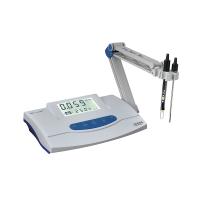
A damage Detector can be used instead of the metal plate: conduct electricity on the surface of the filter paper using a brush connected to the bright pole of the power supply. (Related instrument: conductivity meter)
To saturate the filter paper, use an electrolyte consisting of 36.8 grams of potassium ferrohydrinate, 11.7 grams of phosphonium in 2.00 milliliters of water and 5 milliliters of 17% nitric acid solution. (Related instrument: PH meter)
An electrolyte composed of 190 ml of 11.7% gasification solution and 10 ml of 36.8% potassium ferrocyanide solution can also be used. (Related instrument: Ion Meter)
When measuring the porosity of the phosphoric acid layer on the iron surface, a solution newly prepared by 1% potassium ferrocyanide, 3% gasification passivation and 96% distilled water can be used, and the well in the solution must be added 2 ml of 3% hydrogen peroxide solution.
Dip the tested film in the solution for 10-30 seconds.
In order to effectively measure the porosity of the phosphating layer, some quick methods for measuring the corrosion resistance of phosphating workpieces proposed by Akimov and Ulyanov can be used. According to one of the methods, it is to drop the reagent on the surface of the workpiece with a dropper, record the time according to the stopwatch, and then pay attention to the change of the color of the droplet. The time it takes for the paint to change from sky blue to light green and then to yellow or red is recorded by a stopwatch. The time elapsed between the dropping of the droplet and its color change (in gold fractions) can be used as an indicator (specification) of the corrosion resistance of the phosphating layer. The longer this period of time, the more stable the phosphating layer. The corrosion resistance of the normal phosphating layer is 5 minutes; in order to measure the porosity of the phosphating layer, 1-2 minutes is enough. The components of the reagents used are a mixture of 40 ml of 0.4M CuS04·5H20 solution, 0.20 ml of 10%: NaCl solution and 0.3 ml of 0.1 pass HCl solution.