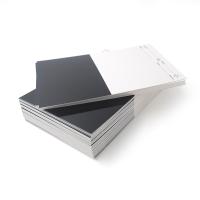
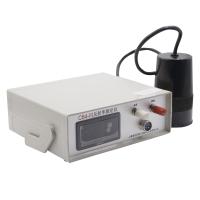
In the coating industry, hiding power is a crucial performance indicator, which directly affects the quality and use effect of coatings. Hiding power refers to the amount of paint required to completely cover the background color of the base material surface when the paint covers the surface of the base material. Therefore, a coating with good hiding power can not only improve the aesthetics of the coating, but also effectively cover the color of the substrate, reduce the see-through of the substrate, and improve the protective performance of the coating. Hiding power is measured to evaluate the covering performance of a paint, i.e. the minimum amount of paint required to cover the surface of a substrate. This is very important because hiding power directly affects the quality and effectiveness of the paint. Coatings with good hiding power can effectively cover the color of the substrate, improve the aesthetics of the coating, reduce the see-through of the substrate, and at the same time improve the protective performance of the coating. Therefore, measuring hiding power can help coating manufacturers evaluate the performance of their products and ensure that they will achieve the desired results in actual applications.
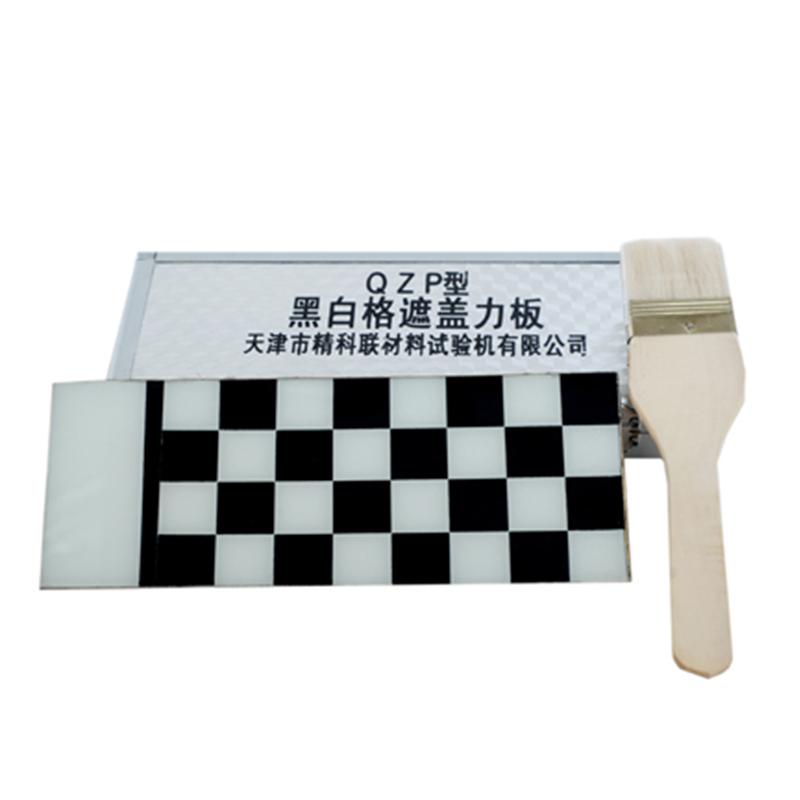
In order to accurately measure the hiding power of paint, a black and white grid glass plate is usually used as the base material. After applying the pigment paste, the minimum amount of paint required to completely cover the black and white grid is observed. The specific steps for measuring hiding power include first preparing a black and white grid glass plate and ink-adjusting oil, then weighing the sample and grinding the ink-adjusting oil, and then using a paint brush to evenly apply the pigment paste on the black and white grid to avoid coating the plate. edge, and finally observe the covering of the black and white grid under light in the dark box. The method of measuring the hiding power is to calculate the mass difference between the black and white grid after painting and the mass difference before and after painting, combined with the painting area and the amount of pigment used, to express the hiding power in terms of the amount of pigment per unit area (g/m2).
The following are the specific steps and methods for measuring hiding power:
1. Prepare materials and equipment:
Black and white grid glass plate: The black and white grid area is 2x10 4 mm 2 .
Paint brush: width between 25mm~35mm.
Container: Capacity is 50mL~100mL.
Ink adjusting knife: 178mm long, width between 7mm~18mm.
Balance: The sensitivity is 0.2g.
Flat Grinder.
Camera obscura: The outer dimensions are 500X400X600mm, and the interior is coated with matte black paint.
2. Measurement method:
First, weigh 3g5g of the sample, and weigh 1/31/2 of the total amount of ink-mixing oil, and grind and blend.
Weigh the mass of the black and white grid on the balance, and use a paint brush to evenly apply the pigment paste on the black and white grid. When applying, be careful not to allow the pigment paste to adhere to the edges of the board.
Observe in the dark box. When the black and white grids are just covered by the pigment paste, record the quality of the black and white grids after painting.
Calculate the hiding power X (g/m 2 ) according to the formula.
3. Hiding power calculation formula:
Hiding power X(g/m 2 ) = 50m(m 1 - m 2 ) / (m + m 3 )
4. Result evaluation:
When the relative error of parallel measurements is not greater than 10%, the average value is taken as the measurement result.
Through the above measurement methods, the hiding power of coatings can be accurately evaluated and provide a scientific basis for coating production and application. This measurement method is simple and reliable, and is widely used in the coating industry.