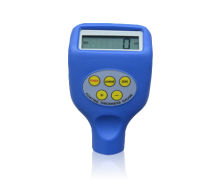
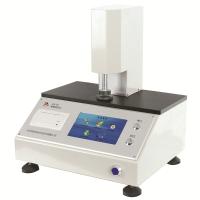
With the rapid development of construction, automobile, electric power and other industries, hot-dip galvanized steel, as a commonly used anti-corrosion material, has been widely used in various fields. Ensuring that the thickness of the surface coating of hot-dip galvanized steel meets standard requirements has become one of the important aspects of quality control. As an instrument specially used to measure the thickness of hot-dip galvanizing layer, the hot-dip galvanizing thickness meter plays a vital role. This article will deeply explore the principles, applications and future development trends of hot-dip galvanizing Thickness Gauges.
Principle analysis
The hot-dip galvanizing thickness meter is a device that uses the principle of magnetic induction to measure the thickness of the hot-dip galvanizing layer. The main principle is to apply an external alternating magnetic field on the surface of the magnetic substrate. When the magnetic induction line passes through the surface of the substrate and is intercepted by the hot-dip galvanized layer, the induced current generated will be affected by the thickness of the hot-dip galvanized layer. By measuring the magnitude and phase changes of the induced current, the thickness of the hot-dip galvanized layer can be determined.

Application areas
Hot-dip galvanizing Thickness Gauges are widely used in construction, automobiles, electric power and other fields. First of all, in the construction industry, hot-dip galvanized steel is often used in building structures, roof panels, guardrails and other fields. By using a hot-dip galvanizing thickness meter, the coating thickness can be measured promptly and accurately to ensure the quality and durability of building materials. Secondly, in the field of automobile manufacturing, hot-dip galvanized steel sheets are often used in the manufacture of automobile bodies, doors and other components. By using a hot-dip galvanizing thickness meter, the coating thickness of automobile steel plates can be detected to ensure the anti-corrosion performance and service life of automobile parts. In addition, in the power industry, hot-dip galvanized steel is often used in the manufacture of transmission lines, power towers and other facilities. By using a hot-dip galvanizing thickness meter, the coating thickness of power facilities can be monitored to ensure the safety and reliability of the facilities.
With the continuous advancement of science and technology, hot-dip galvanizing Thickness Gauges are also constantly undergoing technological innovation and improvement. In the future, with the development of materials science, sensor technology and other fields, hot-dip galvanizing Thickness Gauges will become more and more precise and intelligent. By using advanced sensor technology and data processing algorithms, rapid and accurate measurement of hot-dip galvanizing layer thickness can be achieved, improving measurement accuracy and stability. In addition, with the development of intelligent manufacturing technology, hot-dip galvanizing Thickness Gauges will also achieve a higher level of automation and intelligence. By using advanced control systems and remote monitoring technology, remote control and data management of the measurement process can be achieved, improving production efficiency and quality control levels.
Conclusion
As an important equipment for measuring the thickness of hot-dip galvanizing layer, hot-dip galvanizing thickness meter plays an irreplaceable role in construction, automobile, electric power and other fields. By in-depth understanding of its principles, strengthening technological innovation, and continuously improving measurement accuracy and intelligence levels, we can better meet the needs of various industries for quality control of hot-dip galvanized materials and promote the development and progress of related fields. It is believed that in the near future, with the continuous advancement of science and technology, hot-dip galvanizing Thickness Gauges will play a more important role in the fields of industrial production and quality control, contributing to the promotion of industrial development and technological innovation.