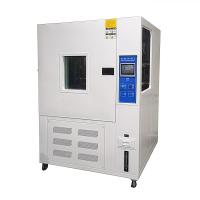
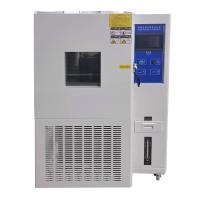
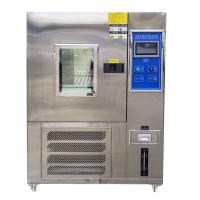
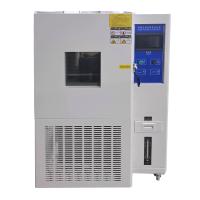
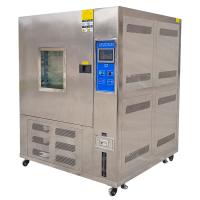
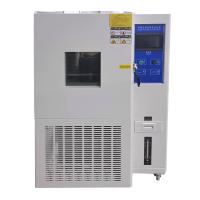
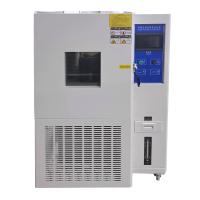
The constant temperature and humidity Test Chamber is a kind of experimental equipment widely used in scientific research and engineering practice. Its ability to conduct experiments and tests under simulated various environmental conditions provides strong support to researchers and engineers in many fields. This article will discuss the principles, application fields and future development directions of constant temperature and humidity Test Chambers, with a view to providing readers with a reference for in-depth understanding and understanding of this important equipment.
Principle structure
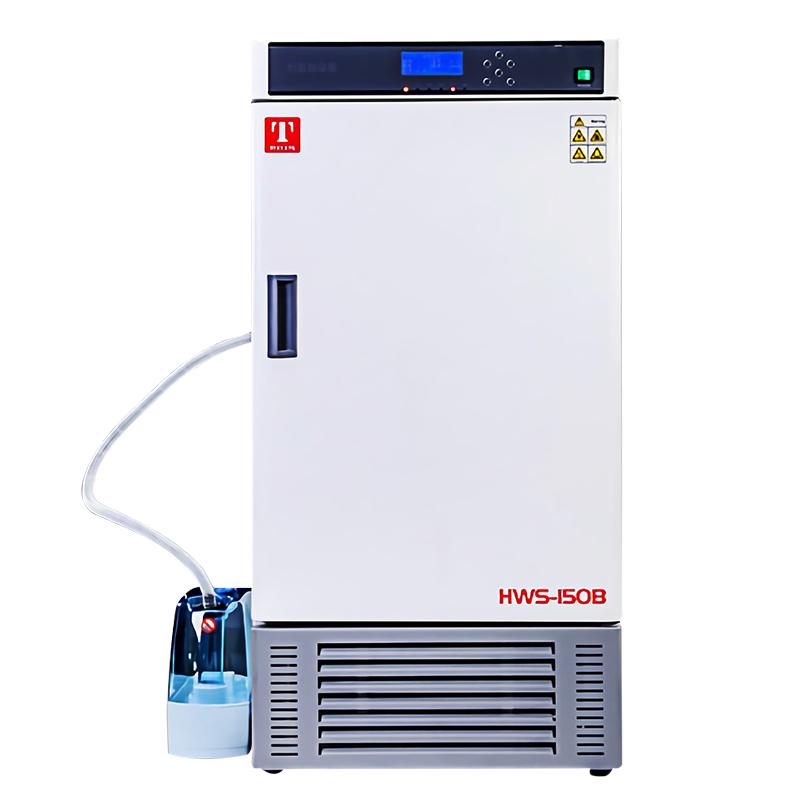
The constant temperature and humidity Test Chamber simulates different environmental conditions by controlling the temperature and humidity inside the Test Chamber to conduct various experiments and tests. Its basic principle is to control the temperature and humidity parameters inside the Test Chamber through heating, cooling, humidification and dehumidification to stabilize it near the set value. A typical constant temperature and humidity Test Chamber usually consists of a control system, a heating and cooling system, a humidity control system, and the Test Chamber body. The control system is responsible for monitoring and adjusting the temperature and humidity parameters inside the Test Chamber, and controls it according to the parameters set by the user. The heating and cooling system uses heaters, refrigerators and other equipment to adjust the temperature inside the Test Chamber and keep it near the set value. The humidity control system uses humidifiers, dehumidifiers and other equipment to control the humidity inside the Test Chamber to meet the test requirements. The body of the Test Chamber is a space that accommodates test samples. It usually has good sealing and heat insulation properties to ensure the stability of test conditions.
Application areas
Constant temperature and humidity Test Chambers are widely used in various fields. In the field of materials science and engineering, constant temperature and humidity Test Chambers are often used in material performance testing, durability evaluation, and new material research and development. By simulating different environmental conditions, the performance of materials in different temperature and humidity environments can be evaluated, providing a basis for material selection and design. In the field of electronic product R&D and testing, constant temperature and humidity Test Chambers are usually used for reliability testing and environmental adaptability testing of electronic components. By simulating various extreme environmental conditions, the performance of electronic products in different environments can be evaluated and their stability and reliability improved. In the pharmaceutical field, constant temperature and humidity Test Chambers are often used for storage and stability testing of pharmaceuticals. By simulating the storage environment of drugs under different temperature and humidity conditions, the stability and shelf life of drugs can be evaluated to ensure the quality and safety of drugs. In the field of food processing and storage, constant temperature and humidity Test Chambers are often used to simulate food storage conditions and evaluate quality. By simulating different temperature and humidity conditions, the shelf life and quality changes of food in different environments can be evaluated, providing a scientific basis for food processing and storage.
With the continuous advancement of science and technology and the increasing application demands, constant temperature and humidity Test Chambers are also constantly developing and improving. Future constant temperature and humidity Test Chambers will be more intelligent and automated, with more intelligent control systems and more flexible operating interfaces, enabling real-time monitoring and remote control of the test process, improving test efficiency and accuracy. Future constant temperature and humidity Test Chambers will pay more attention to energy conservation and environmental protection, using more energy-saving refrigeration and heating equipment and more environmentally friendly refrigerants to reduce energy consumption and environmental pollution and achieve sustainable development. Future constant temperature and humidity Test Chambers will be more multi-functional and diversified. They can not only achieve constant temperature and humidity test conditions, but also simulate other special environmental conditions to meet the test needs of different fields.
Conclusion
As an important experimental equipment, the constant temperature and humidity Test Chamber is of great significance to scientific research and engineering practice. By simulating various environmental conditions, it provides strong support for researchers and engineers in various fields. With the continuous development of science and technology and the changing application needs,