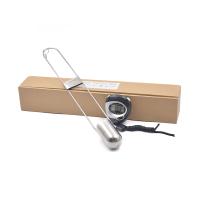
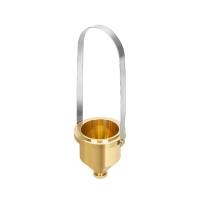
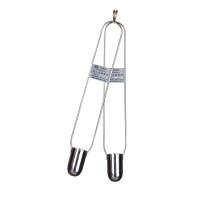
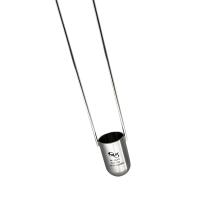
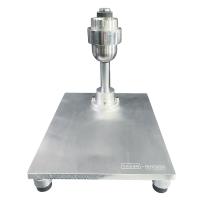
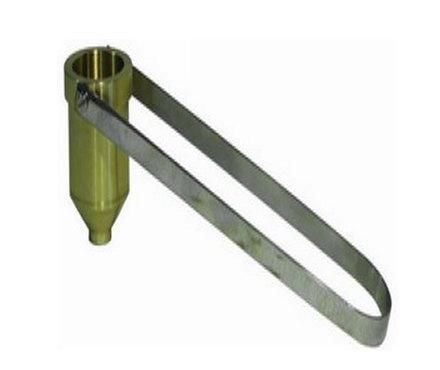
The paint juice Viscosity Cup is a professional instrument used to measure the viscosity of liquids such as paints and coatings. It is widely used in paint, coatings, chemical and other industries. This article will delve into the principles, applications and selection of paint juice Viscosity Cups to help readers better understand and choose a Viscosity Cup that suits their needs.
principle
The measurement principle of the paint juice Viscosity Cup is based on Stokes' law in fluid dynamics, that is, the viscosity is inversely proportional to the liquid flow rate and the size of the fluid tube. Its main principles can be summarized as follows:
First, pour the paint or coating to be tested into the Viscosity Cup, and then tilt the Viscosity Cup along a certain height so that the liquid flows out from the small hole at the bottom of the Viscosity Cup to form a free fall flow.
Secondly, use a timer to record the time from the beginning to the end of the liquid flowing out, and calculate the flow rate based on the time and the volume of the liquid flowing out.
Finally, according to Stokes' law, the viscosity of the liquid is calculated based on the flow rate and the size of the Viscosity Cup.
application
Paint juice Viscosity Cups are widely used in paint, coating, chemical and other industries. In the production process of paints and coatings, Viscosity Cups are used to detect the viscosity of raw materials and finished products to control the production process and ensure stable product quality. In quality testing, Viscosity Cups are used to test whether the viscosity of paints, coatings and other products meets standard requirements to determine whether the product is qualified. By monitoring the viscosity changes of paints and coatings, we can adjust production process parameters, optimize the production process, and improve product quality and production efficiency. In the formulation design of paints and coatings, Viscosity Cups are used to evaluate the viscosity of liquids in different formulations and guide formulation design and optimization.

Selection
Choosing a suitable paint juice Viscosity Cup requires choosing a Viscosity Cup with a suitable viscosity range according to actual needs. Generally, the viscosity range of a conventional Viscosity Cup is between 20 and 10,000 centipoise. Consider the material of the Viscosity Cup. Generally, glass, stainless steel and other materials are available. Choose the appropriate material according to actual needs. Consider the measurement accuracy of the Viscosity Cup and choose a Viscosity Cup with high precision and good stability to ensure the accuracy of the measurement results. Consider the size specifications of the Viscosity Cup and choose the size that suits your sample volume to ensure a stable and reliable measurement process. Consider whether the Viscosity Cup is equipped with corresponding accessories, such as stands, stirrers, etc., to make measurement operations more convenient.
Conclusion
As an important paint testing instrument, the paint juice Viscosity Cup plays an important role in the paint, coating, chemical and other industries. By understanding its principles, applications and selection guide, readers can better select and use a Viscosity Cup that suits their needs, providing better support and guarantee for product quality control and process optimization.