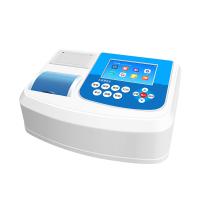
Digestion device preheating:Turn on the power of the digester, select the total nitrogen digestion mode (125°C, 30min), press confirm (or start), and the digester will automatically heat up and preheat;
Concentration prediction:Before testing the water sample, first predict the total nitrogen value of the water sample, and select the operation steps corresponding to the range, e.g., predict the total nitrogen concentration value to be 0-Between 20mg/L, you need to select the operation step of 0-20mg/L range; If the total nitrogen concentration is expected to be 20-100mg/L, the 20-100mg/L range is chosensteps.
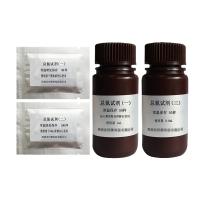
Notes:[3.2mL (10+1) sulfuric acid and 0.8mL total nitrogen reagent (three)], it is generally recommended to use separate amounts; If the test frequency is high,The total nitrogen reagent (3) can also be diluted 5 times with (10+1) sulfuric acid for later use, and 4mL can be directly added to the test tube when used (Note: Mix after dilution 5 timesThe mixture has a short shelf life, so please use it as soon as possible after dilution, please consult the manufacturer or sales representative for details. Tubes after total nitrogen digestion can be difficult to clean, so they can be selectedSeveral tubes are dedicated to the digestion of total nitrogen.
1. When the predicted value is in the range of 0-20 0L mg/L
If total nitrogen is present, the water sample will appear brownish-yellow, and the darker the color, the higher the concentration value of the water sample. Analytical procedure: total nitrogen L; Watch out for overrange tips!

2. When the predicted value is in the range of 20 - 100mg/L
If total nitrogen is present, the water sample will appear brownish-yellow, and the darker the color, the higher the concentration value of the water sample. Analytical Procedure: Total Nitrogen H; Watch out for overrange tips!

3. When the predicted value exceeds 100 mgL /L
The water sample needs to be diluted to the corresponding concentration value in sections 1-2 above, and then operated according to the corresponding range, and the determination result is multiplied by the dilution factor.
4. Test steps on the computer

5. Precautions
◆ If there is total nitrogen, the water sample is brownish-yellow, and the darker the color, the higher the concentration value of the water sample.
◆ Pay attention to cross-contamination, use different measuring utensils for different liquids (pay attention to changing the tip when using a pipette).
◆ Use a suitable pipette to take the liquid, do not use a 5mL pipette to remove 2mL and less liquid, less than or equal to 2mL of liquid, it is recommendedPipette 2 times with a 1mL pipette.
◆ When using a pipette, it is necessary to calibrate the pipette frequently (it is recommended to do so once a week), and pay attention to replacing the tip during use.
◆ The protective cover must be covered during the heating and digestion process of the digester. During the digestion process, beware of scalding, pay attention to the high temperature area of the digester.
◆ After the digestion tube is taken out from the digester, take one piece at a time, it is forbidden to take out multiple tubes at the same time, pay attention to the high temperature, and prohibit shaking.
◆ The cooling process can be natural cooling or water cooling, but the temperature must be below 100°C to be water-cooled.
◆ The digested water sample must be completely cooled before proceeding to the next step.
◆ The digested sample tube must be clear and translucent (colored, but must not be turbid and free of suspended solids)
6. Collection and storage of total nitrogen samples
◼ Samples should be collected in a clean glass or plastic container with at least 100 mL of sample. Immediate analysis after sampling yields more reliable results.
◼ The results are most reliable for analysis immediately after sampling. If this is not possible immediately, use sulfuric acid (2 mL of concentrated sulfuric acid/L water) to adjust the pH of the sample to 2 or 2under Save. Store samples at 4 °C. Samples can be stored for up to 28 days.
◼ Before sampling, the sample cell should be stirred evenly to collect a homogenized sample containing solid particulate matter to ensure that the sample is representative (total nitrogen is divided into total filterableNitrogen and total nitrogen. (1) Filterable total nitrogen: refers to the nitrogen content of soluble and filterable solids (less than 0.45μm particles) in water. (2) Total nitrogen: refers to solubleand nitrogen content in suspended particles. Therefore, the detection target should be clarified before sampling for testing. )。
◼ Before testing and analyzing, heat the sample to room temperature, neutralize the sample acidity with a 5.0N sodium hydroxide solution, and adjust the pH of the sample to neutral. rootThe test results were corrected according to the increase in sample volume.
7. Accuracy check
Use the Total Nitrogen Standard to verify the accuracy of the instrument or if there are any problems with its operation. Total nitrogen standards can be obtained by purchasing national quality control samples, or conditionsPrepare your own where permitted.
Total Nitrogen Standard Solution Method
Preparation of total nitrogen standard sample (100mg/L): weigh 0.7218g of potassium nitrate (GR) dried by constant weight at 105 °C ~ 110 °C, dissolved in an appropriate amount of distilled water, and turnedPipette the solution in a 1000ml volumetric flask, dilute it with distilled water to the marking, add 2ml of chloroform as a preservative, mix well, and be stable for at least 6 months.
Verification of accuracy
Dilute the standard solution to the required concentration, and test it according to the corresponding operation steps to observe whether the test result is consistent with the actual concentration value of the standard solution.
8. Methods review
The alkaline persulfate digestion process converts all forms of nitrogen into nitrate nitrogen. After digestion, sodium metabisulfite is added to remove halogensOxidizing substances. The nitrate reacts with the color-changing acid in a strongly acidic environment to form a yellow complex, which is positive in color with the total nitrogen concentrationThe total nitrogen value of the sample was calculated by spectrophotometry and microcomputer technology.