Color is one of the important indicators in the quality evaluation of liquid products. Whether it's a varnish, clear oil or other liquid coating, the depth of its color is directly related to the composition of the product, its purity, and the final film-forming performance and range of use. In this article, we'll take a deep dive into the significance of color in liquid products, as well as the commonly used methods for determining color.
The importance of color
Color is an intuitive property that reflects the composition and purity of a product. In liquid products, the depth of color not only affects the appearance quality of the product, but also directly relates to the performance and use of the product. In general, lighter colors are better, because colors that are too dark are not suitable for making high-gloss paints, nor are they suitable for making white or light-colored paints. Therefore, the determination of color is not only an important indicator of product quality, but also a key item in the control of raw materials and semi-finished products.
Color determination method
Standard color scale method
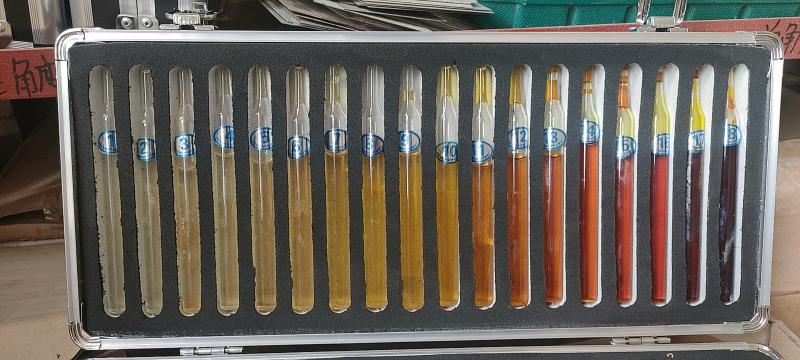
This is a common method of color determination. The principle is to use the absorption of light by transparent liquid to produce different shades of color under the transmission of light from a fixed artificial light source. In accordance with the provisions of GB/T 1722-92 "Color Determination Method for Varnishes, Clear Oils and Diluents", the specimen is packed in a test tube and compared with a series of standard color gradation solutions by visual method in a wooden camera obscura or Colorimeter. The results are expressed in the color that is closest to the color scale solution of the iron-cobalt Colorimeter, i.e., with No. 1 being the lightest and No. 18 being the deepest.
Rovipun's colorimetry
This method is a method in GB/T 1722-92. It uses a Rovipon Colorimeter for color determination. The specimen is loaded into the sample cell of the Rovipon Colorimeter, and then visually matched to the specimen using the red, yellow, and blue primary color filters labeled with the Rovibon color scale unit values. When the matching color is consistent with the color of the specimen, the color of the specimen is expressed as the chromaticity scale unit value of the three color filters. For visual matching, if the specimen is darker, a neutral gray gel is added to the sample cell to make the color and brightness exactly the same.

The determination of color is of great importance in the production of liquid products. Through color determination, we can quickly and accurately assess the quality of the product and adjust the production process in time to ensure that the product meets the expected appearance and performance requirements. Therefore, familiarity with and mastery of color determination methods is a critical part of the production process of liquid products.
