Atomic Absorption Spectrometer (AAS) is an important analytical instrument used to measure the amount of metallic elements in a sample. It is based on the phenomenon of atomic absorption, which is analyzed using the principle of absorbing a beam of light from a specific spectral line of the element to be measured.
1. Working principle
Atomic absorption spectroscopy is based on atomic absorption spectrophotometry, which excites the elements in the sample to be measured by a specific light source, so that their atoms absorb a specific wavelength of light from the ground state. After the light passes through the sample, the Detector measures the change in the intensity of the light, measuring that the amount of absorption is proportional to the concentration of the elements in the sample. Instruments include light sources (e.g., hollow cathode lamps), atomizers (e.g., flame atomizers or graphite furnaces), spectroscopic systems, and detection systems. The advantages include high sensitivity, accuracy, and a wide range of applications, but it presents challenges in analyzing conditions and interferences between different elements.
The atomic absorption spectrometer is analyzed by the following steps:
Light source provided
The light source is usually a hollow cathode lamp (HCL), which produces specific spectral lines of the element to be measured.
Sample handling
Converts the sample into a vapor or atomic state. Commonly used atomizers are flame atomizers and non-flame atomizers, such as high-temperature graphite furnaces.
Spectral measurements
The amount of light that passes through the sample and is absorbed is proportional to the concentration of the element to be measured in the sample.
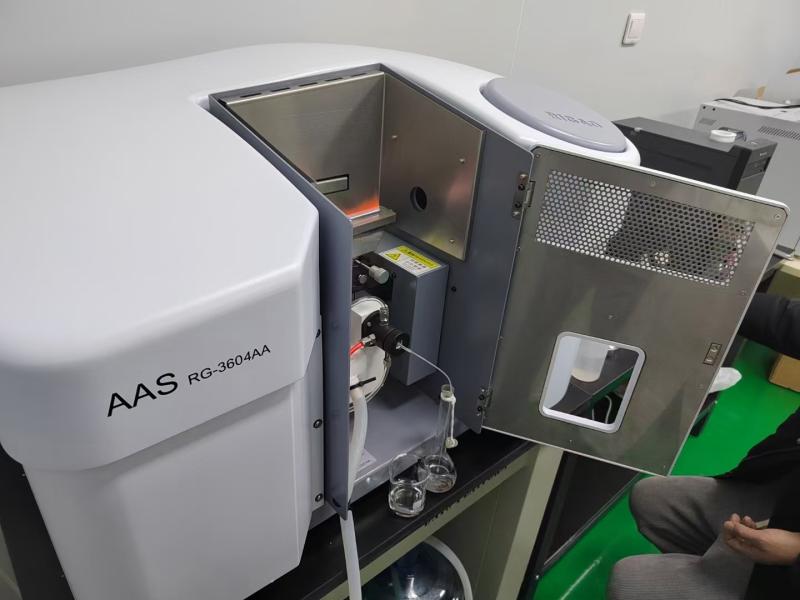
2. Structure and composition of the instrument
The atomic absorption spectrometer is usually composed of four parts: the light source, the sample processing system, the spectroscopic system and the detection system. The light source is usually a hollow cathode lamp or other specific light source that is used to produce a specific wavelength of light to excite the elements in the sample to be measured. The sample handling system includes an atomizer with the option of a flame atomizer or a graphite furnace for atomizing elements in the sample for subsequent spectroscopic analysis. The spectroscopic system is responsible for separating specific wavelengths of light and directing it to the detection system. Detection systems typically consist of photocells or photomultiplier tubes that measure how well a sample absorbs light at a specific wavelength to infer elemental concentrations or amounts.
These components work in tandem, with the light source providing the excitation energy, the atomizer atomizing the sample, the spectroscopic system separating and directing the light at a specific wavelength, and the final detection system measuring the amount absorbed. This structure enables the atomic absorption spectrometer to perform elemental analysis with high sensitivity and accuracy, and is widely used in environmental monitoring, food safety, medicinal chemistry and other fields.
The atomic absorption spectrometer is mainly composed of the following parts:
light source- Usually a hollow cathode lamp, which produces the spectral line light of the element to be measured.
Hollow cathode lamp- A commonly used light source that generates element-specific spectral lines through discharge excitation.
High-intensity hollow cathode lamp- Increases the light intensity without increasing the spectral line width.
Multi-element hollow cathode lamp- It can measure multiple elements at the same time to improve efficiency.
Atomizer- Converting the sample to an atomic state.
Flame atomizer- Flame is used to convert a liquid sample into an atomic state.
Non-flame atomizers– e.g. high-temperature graphite furnaces, suitable for liquid or solid samples.
Spectroscopic system- Separation and selection of specific spectral lines for transmission to the detection system.
Detection system- Measure the intensity of the absorption spectrum and calculate the concentration of the element to be measured in the sample.
3. Features and advantages
Atomic absorption spectroscopy is highly selective and sensitive, enabling accurate measurement of trace element levels in a sample, often down to ppb or even lower. Its wide range of applications covers the analysis of liquid, solid and gaseous samples and is suitable for environmental monitoring, food safety, pharmaceutical analysis and many other fields. In addition, the sample pretreatment of atomic absorption spectrometer is relatively simple, and only dissolution and dilution are required for liquid samples, and only a few preparation steps are required for solid samples, which greatly improves the experimental efficiency and analysis speed.
In addition, the AAS has a wide linear dynamic range and is able to make accurate measurements at a wide range of concentrations, from micro to highly concentrated samples. Stability and reliability are another significant advantage, and modern instruments are equipped with a stable light source and detection system that can operate stably for long periods of time without the need for frequent calibration and maintenance. These features make atomic absorption spectroscopy an indispensable and important tool in the laboratory, providing a reliable analytical solution for scientific research and industrial applications.
4. Application and limitations
Atomic absorption spectrometers are used in a wide range of applications, such as:Industrial Analysis,environmental monitoringFood Safety,Medicine, etc.
For example, in environmental monitoring, it can be used to detect trace heavy metals and pollutants in water and soil to provide data support for environmental protection. In terms of food, it can quickly and accurately detect trace elements in food to ensure food quality and safety. It can also be used for the quantitative analysis of active ingredients in drugs and the detection of residues. In addition, atomic absorption spectrometers are widely used in industrial control, such as composition analysis and quality control in the production of metal products.
However, atomic absorption spectroscopy also has its limitations. For example, complex sample matrices, such as those with high salinity or high organic content, can affect the accuracy of the analysis. Atomic absorption spectroscopy has certain limitations in multi-element analysis, and each element needs to be determined separately, and multiple elements cannot be analyzed at the same time. For applications that require extreme sensitivity or specific analytical methods, other, more specialized analytical instruments may be required. Therefore, when selecting an atomic absorption spectrometer for application, it is necessary to consider the nature of the sample and the specific requirements of the analysis to ensure accurate and reliable analytical results.
