Potentiometric analysis is an analytical technique based on measuring the change in electromotive force of a battery to determine ion activity during a chemical reaction. Its history dates back to the early 19th century, when chemists began to use potentiometry techniques to study and quantify electrochemical phenomena in chemical reactions. With the progress of science and technology and the deepening of theoretical research, potentiometers and ion-selective electrodes play an important role in analytical chemistry as key tools. Potentiometers measure potential changes to determine the titration endpoint, while ion-selective electrodes respond highly selectively to specific ions and are widely used in water quality monitoring, biochemistry and the pharmaceutical industry. These techniques not only improve the accuracy and efficiency of analysis, but also promote innovation and development of chemical analysis methods.
Classification and characteristics
Potentiometer
Potentiometers are one of the instruments commonly used in chemical analysis to measure electromotive force to determine the activity of specific ions in a solution. There are two main methods: direct potentiometric method and potentiometric titration method.
Direct potentiometric method
Direct potentiometric method is a method for determining the activity of ions to be measured based on measuring the electromotive force of the battery. By measuring the potential change of the electrode, it directly reflects the change in the concentration of ions in the solution, which is suitable for ion analysis sensitive to potential changes, such as H+, Ag+, etc.
Potentiometric titration
The potentiometric titration method is a method of determining the end point of titration by measuring the change in the electromotive force of the battery during the titration. During the titration process, the change in potential is measured by the continuous addition of titrant to determine the concentration of the ions to be measured in the solution. This method is particularly suitable for analyses that require high precision and complex chemical reactions, such as determination of pH, complex content, etc.
Ion-selective electrodes
An ion-selective electrode is an important electrochemical sensor that generates a potential signal based on changes in the activity of specific ions in a solution. They have a long history and technical background, starting with early experiments in the early 20th century.Ion-selective electrodes are widely used in the following main types and applications:
pM-responsive glass membrane electrode
Based on the doping of specific metal oxides in the glass film, it is sensitive to metal ion activity. It is suitable for the determination of cations such as Na+ and K+, and is often used in environmental monitoring, biological sample analysis and other fields.
Ion-selective electrodes for solid-state membranes
Solid-state membranes made of single crystal or thin-film materials that respond selectively to specific ions, such as fluoride selective electrodes. It is mainly used in water quality monitoring, ion determination in industrial processes, etc.
Liquid membrane ion-selective electrodes
Ion exchangers are dissolved in organic solvents to form liquid films that are sensitive to specific ions, such as Ca2+ ion-selective electrodes. It is suitable for ion determination in complex solutions, such as biological samples, soil measurements, etc.
Technical principle
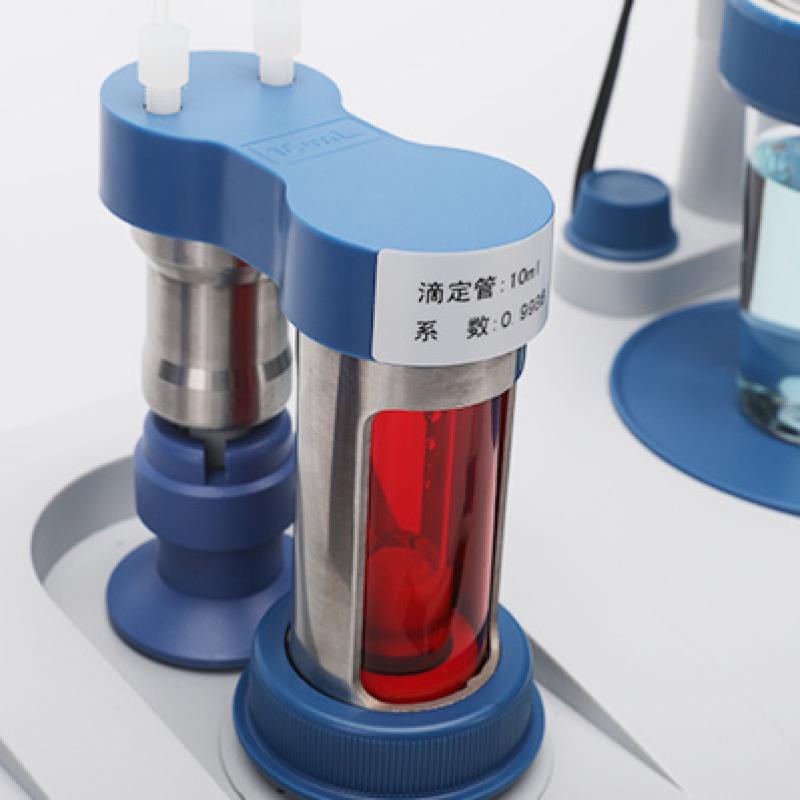
A potentiometric titrator is an instrument used to measure the endpoint of a chemical reaction, which is mainly composed of a burette, a titration cell, an indicator electrode, a reference electrode, a stirrer and a measuring instrument. During potentiometric titration, the titration endpoint is determined by measuring the change in electromotive force. The burette contains the solution to be measured, when the titrant is added, the indicator electrode and the reference electrode monitor the potential change, the stirrer ensures that the solution is evenly mixed, and the final measuring instrument records the change in electromotive force to determine the endpoint and calculate the concentration of the substance to be measured.
In potentiometric titration, the instrument used to measure the electromotive force is usually a potentiometer or a DC millivoltmeter. Potentiometers are suitable for measuring potential changes over a wide range and are easy to use but require correction by measuring the potential difference between the indicator electrode and the reference electrode. The DC millivolt meter is more sensitive to potential changes over a small area and has high accuracy, making it suitable for accurate potential measurement and real-time recording.
Ion-selective electrodes can be divided into glass membrane electrodes, solid-state membrane electrodes and liquid membrane electrodes according to their working principles and structures.
Glass membrane electrode
Glass membrane electrodes use the sensitivity of a specific composition of the glass membrane to specific ions to measure potential changes. The metal oxides in the glass film can chemically react with the target ions to produce potential changes, and are often used to measure Na+, K+ and other ions.
Solid-state membrane electrodes
Solid-state membrane electrodes use a solid-state membrane composed of single crystal or thin film materials to generate potential changes through the transfer of ions within the membrane. For example, fluoride-selective electrodes use lanthanum fluoride crystals or other solid membrane materials to measure the concentration of fluoride ions.
Liquid membrane electrodes
Liquid membrane electrodes dissolve ion exchangers in organic solvents to form a liquid film, and the exchange of ions between the organic and aqueous phases results in potential changes. For example, a Ca2+ ion-selective electrode uses calcium dioctyl phosphate dissolved in an organic phase to measure the concentration of calcium ions.
Electrode selectivity is affected by a variety of factors, such as pH, ionic strength, temperature, etc. Adjustment methods include controlling the pH of the solution, using a buffer solution, adjusting the formulation of the electrode material, etc., to improve the selectivity and accuracy of the electrode. Adjusting electrode selectivity is one of the key steps to ensure accurate and reliable analytical results
Applications & Benefits
Potentiometric titration has a wide range of applications in analytical chemistry as a method for accurately measuring endpointsThe titration endpoint can be determined by measuring the change in potential, which is more accurate than the visual indicator method and is particularly suitable for the analysis of color-indistinguishable or colored samples.It can be applied to the determination of various ion concentrations, including pH determination, complex analysis and other fields.Potentiometric titration is usually faster and easier to perform than conventional analytical methods, allowing the analysis of large numbers of samples in a short period of time.
Determination of the titration endpoint is a critical step in potentiometric titration, and commonly used methods include:
E-V curve method
By plotting the potential as a function of the volume of titrant added, the potential abrupt change point was found as the end point.
ΔE-V curve method
The rate of change of the potential as a function of the titrant volume is calculated to find the maximum slope point as the titration endpoint.
Second-order differentiation
The location of potential mutations is determined by calculating the second derivative of the potential, further improving the accuracy of the endpoint.
Ion-selective electrodes have a wide range of applications in various fields due to their high selectivity and fast response characteristics, egEnvironmental monitoring, the use of ion-selective electrodes can monitor the concentration of various ions in water quality in real time, such as fluoride ions, chloride ions, etc., for environmental protection and water resource management.Ion-selective electrodes are used to determine the sodium content in foodstuffs and help to control product quality and comply with hygiene standards.In pharmaceutical processes, ion-selective electrodes can detect cationic or anionic components in drugs to ensure the quality and stability of drug products. Also availableIt is used to measure nutrients or harmful ions in the soil, evaluate soil fertility and pollution degree, and guide agricultural production and environmental protection.
Ion-selective electrodes have many advantages over traditional analytical methods.The sensor responds quickly and often delivers measurement results within seconds to minutes, saving time. alsoThere is no need for complex sample preparation steps, and measurements can be performed directly in complex samples, reducing the source of error during the experiment.Due to the high selectivity of the sensor for specific ions, it provides precise measurement results and is particularly suitable for low concentrations and trace analysis.
Potentiometers and ion-selective electrodes play an important role in analytical chemistry. The potentiometer accurately determines the titration endpoint by measuring the change of electromotive force, and is widely used in acid-base titration, complex analysis and other fields, especially for the accurate analysis of complex samples. Ion-selective electrodes, on the other hand, are widely used in environmental monitoring, food safety, and pharmaceutical analysis to directly measure the concentration of specific ions due to their high selectivity and fast response, providing an effective solution for fast and easy analysis.
