1. Introduction
A casting machine is a kind of equipment widely used in the production of plastic films, and its working principle is based on the fact that solid plastic particles or powders are heated, melted, and then extruded into a continuous film. The whole process mainly includes several key steps such as raw material handling, extrusion and molding, cooling and treatment.
First, the plastic raw material is added to the feeding system of the casting machine, and through heating and mechanical stirring, the plastic particles are gradually melted into a melt. This melt is extruded into a component called an extrusion head, and typically the pressure and flow control system inside the extrusion head helps ensure that the melt is evenly extruded and forms a continuous film.
After the extrusion head, the melt is fed into the space between a pair of rotating rollers. These rollers are conditioned to gradually flatten and stretch the melt, while a series of cooling rollers gradually reduce the temperature of the film to cure it into the desired thickness and width.
Finally, the formed film is coiled through the winding system to form a large or small roll of the end product. In addition, the casting machine can also be equipped with other post-processing equipment, such as cutting, printing, coating, etc., to meet the needs of different applications.
Casting machines are widely used in the packaging industry (such as food packaging, pharmaceutical packaging), building materials (such as plastic film, waterproof materials), agriculture (such as agricultural film), electronic products (such as thin film batteries) and other fields. With the advancement of technology, casting machines continue to develop and innovate in terms of improving production efficiency, reducing energy consumption and optimizing product quality.
Second, the principle
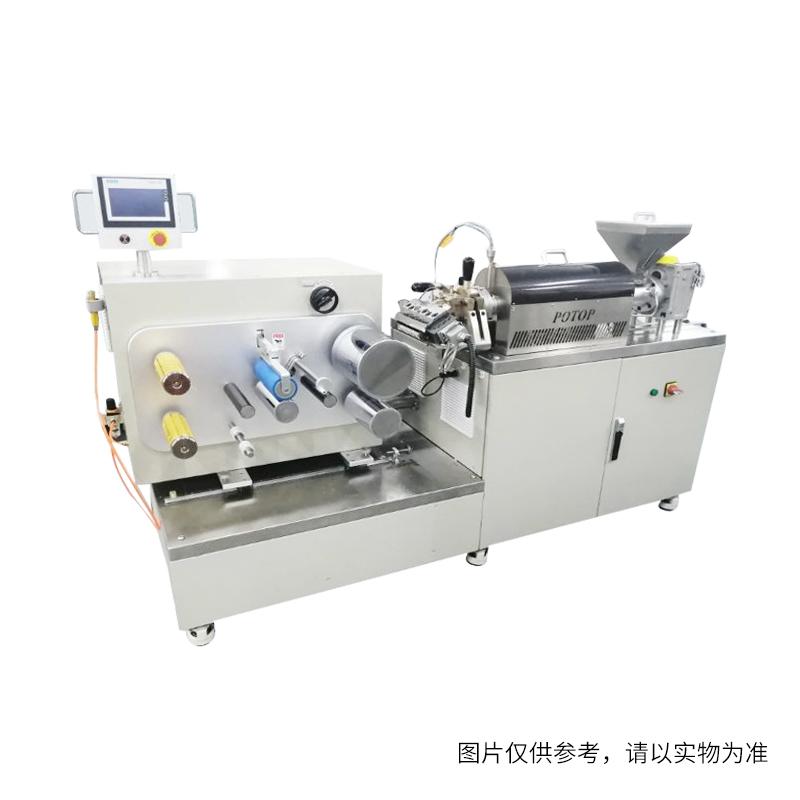
The small casting machine is mainly composed of the following parts: raw material supply system, heating and extrusion system, extrusion head, cooling system and winding system. First, the plastic raw material enters the machine in the form of granules or powders through the raw material feeding system, and after heating and extrusion, it is extruded into the space between a pair of rotating rollers at the extrusion head. These rollers are usually divided into several sections, including cooling rollers, which gradually cool the extruded molten plastic so that it gradually solidifies and forms a film. Finally, the formed film is coiled through the winding system, and at the same time, it can be subjected to subsequent processing such as cutting, printing, etc., to obtain a film product that meets the requirements.
3. Application
Experimental small casting machines have a wide range of applications in a number of high-tech fields, and the following are some of the main application areas:
Electronic ceramics: used to manufacture high-performance electronic components, such as capacitors, inductors, etc. Experimental small casting machines can produce high-quality ceramic films that meet the stringent requirements of electronic components.
Functional films: including conductive films, optical films, barrier films, etc. These films have a wide range of applications in electronics, optics, packaging and other fields.
Medical devices: used in the manufacture of biocompatible materials, such as artificial skin, drug delivery systems, etc. Experimental small casting machines can produce films with special properties to meet the needs of medical devices.
New Materials Research: Experimental small casting machines are an important tool in materials science research, which can help researchers develop and verify the performance and application of new materials.
Fourth, the operation method
The operation method of the experimental small casting machine is relatively simple, but it is necessary to strictly follow the operating procedures to ensure the safety of equipment and personnel. Here are the detailed steps:
Before starting the machine, check whether all parts of the equipment are in good condition, especially the key parts such as the feeding system, melting system, extrusion system, cooling system, etc.
According to the process requirements, the required raw materials are prepared and mixed in proportion. Ensure the uniformity and consistency of raw materials.
The mixed slurry is poured into the hopper of the casting machine, and the feeding system is started to convey the raw materials to the melting system.
The heating system is activated to heat the raw material to the desired temperature and melt it into a flowing slurry. During the heating process, temperature changes need to be closely monitored to avoid overheating or underheating.
The extrusion system is activated to extrude the molten slurry into a film. Adjust the thickness of the scraper and the extrusion speed to control the thickness and uniformity of the film.
The extruded film is fed into a drying unit where it is dried and cured. The drying temperature and time need to be adjusted according to the characteristics of the material.
The dry-cured film is stripped off the baseband to form the final film product.
The film is processed as needed, such as punching, laminating, surface treatment, etc., to make a product that meets the requirements.
5. Precautions for use
The use of experimental small casting machines needs to pay attention to the following aspects to ensure operational safety and product quality:
When operating the equipment, it is necessary to strictly follow the safety operation procedures and wear the necessary protective equipment, such as gloves and protective glasses. Avoid contact with hot parts and moving parts.
Regularly inspect all parts of the equipment and carry out maintenance and maintenance in a timely manner. In particular, key components such as heating systems and extrusion systems are ensured to operate normally.
The quality of raw materials directly affects the quality of the product. Before use, the raw materials must be pre-treated, such as drying, sifting, etc., to ensure that they are pure and uniform.
Strict control of various process parameters, such as heating temperature, extrusion speed, drying time, etc. According to the material and process requirements, adjust the parameters to achieve good results.
The environment in which the experimental small casting machine is used needs to be kept clean, dry and well ventilated to avoid contamination of the product by dust and impurities. Temperature and humidity also need to be kept within the appropriate range.
During the operation of the equipment, if there is a failure, it must be stopped immediately for inspection, and the fault can be continued after troubleshooting. Do not force the use of the device without the fault being eliminated.
In the process of the experiment, the process parameters and operations were recorded in detail, and the data analysis and summary were carried out to provide reference for subsequent experiments and production.
6. Summary
As a high-precision and high-quality production equipment, the experimental small casting machine plays an important role in the development of new materials and process research. Through reasonable operation and strict management, we can produce high-performance films that meet the requirements and meet the needs of various fields. During use, it is necessary to strictly follow the operating procedures to ensure the safety of equipment and personnel.